
Most people don’t realize how much stuff they’ve accumulated until they start packing boxes. That’s when the overwhelm hits. Figuring out how to declutter before moving sounds straightforward, but without a plan, you end up shuffling junk from one room to another, or worse, paying to move things you should’ve tossed weeks ago.
The good news? Two weeks is plenty of time to sort through your entire home if you tackle it room by room. This guide breaks down a practical, day-by-day plan that covers what to keep, what to donate, and what to throw away, so you’re not making these decisions on moving day with a truck idling in the driveway.
And when the "toss" pile inevitably grows bigger than expected (it always does), that’s where we come in. At Dump Express, we deliver dumpsters across Cape Cod and Plymouth seven days a week, so you can clear out everything in one shot instead of making a dozen trips to the dump. Here’s how to get started.
Set your ground rules and gather supplies
Starting without a framework turns a manageable job into chaos. Before you touch a single closet or drawer, set clear expectations and lock in a few personal rules that keep you moving forward instead of second-guessing every item. This upfront work takes less than an hour, and it saves you from the common trap of "maybe I’ll keep it" boxes that somehow end up on the moving truck anyway.
Decide on your timeline and non-negotiables
The 2-week plan in this guide works best when you commit to specific days and hours rather than "whenever I have time." Pick two or three evenings per week plus one full weekend day, and block them on your calendar like appointments. Treat them as fixed, not optional.
Deciding your rules before you start means you spend time sorting, not debating, and that’s the fastest way to get through how to declutter before moving without burning out halfway.
You also need to set a few non-negotiables upfront. Common ones include: nothing gets repacked "just in case" unless you can name a specific scenario where you’ll use it, and any item you haven’t touched in over a year goes in the donate or toss pile by default. Write these down and keep them visible while you work. Here’s a simple rules template you can post on the wall:
| Rule | What it means in practice |
|---|---|
| One year rule | If you haven’t used it in 12 months, it goes |
| Name the scenario | If you can’t say exactly when you’ll use it, let it go |
| No "maybe" boxes | Every item gets labeled: Keep, Donate, Sell, or Toss |
| One room at a time | Finish one space fully before moving to the next |
Gather the right supplies before day one
Scrambling for tape and boxes mid-session kills your momentum. Before your first declutter session begins, collect everything you need so the only decision you’re making is what stays and what goes. Most of this you already own or can pick up at any hardware or home improvement store.

Your supply list:
- Heavy-duty trash bags (at least two box counts’ worth, 30-gallon or larger)
- Cardboard boxes in two or three sizes for donate and sell piles
- Colored markers or sticker labels to mark each box clearly: Keep, Donate, Sell, Toss
- Masking tape for quick sealing and labeling
- A notepad to track high-value items you plan to list for sale
Having your supplies staged and ready means you walk into each session focused. Set up your four designated zones in a central spot like a hallway or garage so items have a clear destination the moment you decide on them, with no lingering in limbo.
Use fast decision tests to sort everything
When you’re standing in front of a full closet, deliberating over every single item drains your energy fast. The secret to moving through your home quickly is running a decision system on autopilot. These short tests replace long debates with clear, repeatable answers, so you spend less time frozen in front of a shelf and more time filling bags.
The goal isn’t to make perfect decisions; it’s to make fast, honest ones you won’t reverse on moving day.
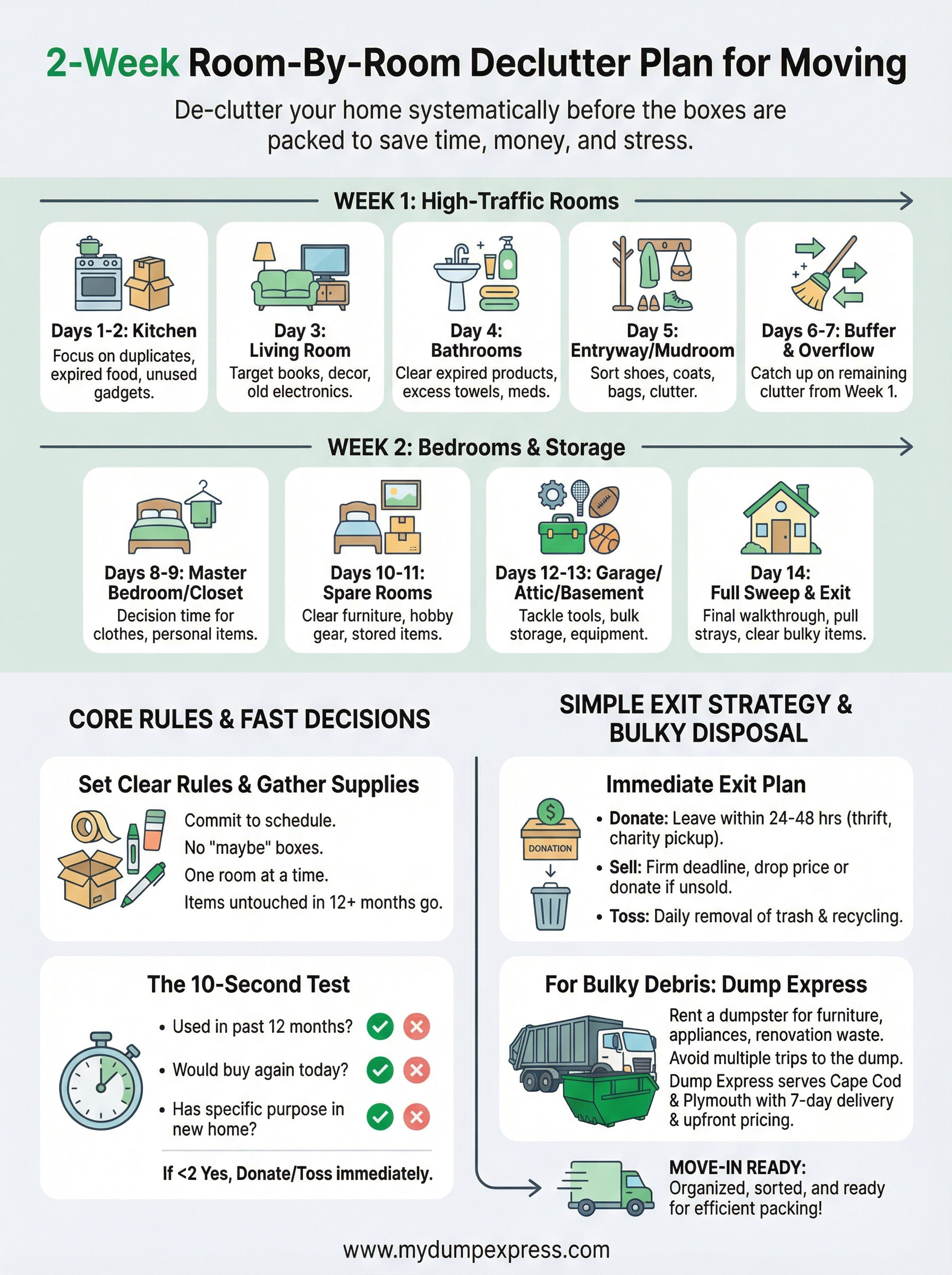
The 10-second test
Pick up an item and ask yourself three quick questions in order. Give yourself 10 seconds total. If you can’t answer yes to at least two of them, it goes in the toss or donate pile with no exceptions.
- Have I used this in the past 12 months?
- Would I buy this again today at full price?
- Does it serve a specific purpose in my next home?
Hesitation is data. If you’re staring at something trying to recall the last time you touched it, that’s your answer. Apply this test consistently to every item before it lands in a pile, and you’ll move through each room far faster.
Category-specific rules for common problem items
Certain categories slow down how to declutter before moving because they carry emotional weight or feel useful even when they’re not. Apply these fixed rules to cut through the indecision without relitigating the same debate room after room:
| Category | Keep it | Let it go |
|---|---|---|
| Clothes | Worn in the last 12 months and fits | Hasn’t fit or been worn in over a year |
| Kitchen tools | Used at least once a month | Has a duplicate or serves only one narrow purpose |
| Books | Will re-read or use as a reference | Finished and won’t revisit |
| Furniture | Fits your new floor plan | Oversized, broken, or redundant |
| Paperwork | Legal, financial, or active documents | Outdated receipts, old manuals, expired records |
Follow the 2-week room-by-room declutter plan
Starting with your busiest, most cluttered spaces forces a quick early win and keeps your energy up through the rest of the process. This schedule runs on daily sessions of 60 to 90 minutes, not marathon all-day sessions. Stick to it, and you’ll have a clear picture of exactly what’s making the move before packing begins.
Week 1: High-traffic rooms first
Week 1 targets the rooms where clutter accumulates fastest: the kitchen, living room, bathrooms, and entryway. These spaces tend to hold duplicates, expired products, and items you stopped using years ago. Working through them first gives you a fast sense of progress and frees up space to stage your donate and sell piles as you continue.
| Day | Room | Focus |
|---|---|---|
| Day 1-2 | Kitchen | Duplicates, expired food, unused gadgets |
| Day 3 | Living room | Books, decor, electronics |
| Day 4 | Bathrooms | Expired products, extra towels, medicines |
| Day 5 | Entryway/mudroom | Shoes, coats, bags |
| Day 6-7 | Buffer days | Overflow from Week 1 rooms |
Week 2: Bedrooms and storage spaces
Bedrooms and storage areas are where how to declutter before moving gets genuinely difficult. Closets, attics, garages, and spare rooms hold items with sentimental weight, old furniture, and years of accumulated boxes that never got unpacked from your last move. Apply your 10-second decision test here without loosening the rules.
If a box has been sealed and untouched since your last move, skip the nostalgia and put it directly in the toss pile.
| Day | Room | Focus |
|---|---|---|
| Day 8-9 | Master bedroom/closet | Clothes, shoes, personal items |
| Day 10-11 | Spare rooms | Furniture, stored items, hobby gear |
| Day 12-13 | Garage/attic/basement | Tools, sports equipment, bulk storage |
| Day 14 | Full sweep | Walk every room and pull any strays |
Move items out fast with a simple exit strategy
Sorting your belongings into piles only works if those piles actually leave your home before moving week. A donate box sitting in your hallway for three weeks has a way of getting picked through and refilled. Build a concrete exit plan for each category from day one, and nothing lingers long enough to find its way back onto the moving truck.
The biggest mistake people make when figuring out how to declutter before moving is sorting thoroughly but then stalling on the exit step.
Get donations out the door immediately
Your donate pile should leave your home within 24 to 48 hours of being filled. Don’t let it accumulate. Schedule a drop-off at a local thrift store like Goodwill or arrange a pickup through a local charity so bags leave your space as soon as they’re ready. Load them directly into your car trunk at the end of each session, so they’re one errand away from gone.
For items in good condition, check whether a local shelter, library, or community center could use them before defaulting to a generic donation bin. Many organizations accept furniture, books, and housewares directly, and some will schedule a free pickup if you have enough volume to make it worth their time.
Sell quickly without slowing your timeline
Selling takes more time than donating, so only pursue it for items with real resale value. Set a firm deadline: if something doesn’t sell within five to seven days of listing, drop the price once and then donate it. Don’t let selling become a reason to hold onto items past your moving date.
Use this quick-sell guide to decide what’s worth listing:
| Item type | Worth listing? | Suggested action |
|---|---|---|
| Furniture in good condition | Yes | List immediately, price to sell fast |
| Small appliances | Yes | Quick listings, bundle similar items |
| Clothes | Only designer or near-new | Otherwise donate |
| Books | Only textbooks or collectibles | Otherwise donate |
| Miscellaneous household items | No | Donate or toss directly |
Plan for bulky debris and dumpster needs
Once your sorting is done, the donate and sell piles have a clear path out. But furniture, broken appliances, old mattresses, and renovation debris don’t fit in a car trunk or a donation bin. These bulky items are where most declutter projects stall. Renting a dumpster is the fastest way to clear them all at once, without making repeated trips to a transfer station or waiting on municipal pickup schedules.
When you’re figuring out how to declutter before moving, underestimating the volume of bulky waste is the single most common reason people hit a wall in the final stretch.
Know what goes in a dumpster
Most household junk, construction debris, and furniture can go straight into a rented dumpster. But certain materials are restricted at disposal facilities and can trigger surcharges or rejected loads if included. Before you start filling, confirm what your dumpster provider accepts.
Common items that typically go in without issue:
- Furniture (sofas, chairs, bed frames, tables)
- Mattresses (check with your provider, some charge a small fee)
- Appliances (washers, dryers, refrigerators without freon removed)
- General household junk and renovation debris
- Cardboard, wood, and flooring materials
Items typically prohibited include hazardous materials like paint, motor oil, propane tanks, and electronics with batteries. Keep these separate and contact your local municipal waste program for proper disposal options.
Choose the right dumpster size
Picking the wrong size either leaves you overflowing or paying for capacity you don’t need. Use this quick reference to match your project to the right container:
| Dumpster size | Best for |
|---|---|
| 5-yard | Small cleanouts, one or two rooms |
| 10-yard | Full-home declutter, small renovation |
| 15-yard | Large furniture loads, multi-room clearing |
| 20-yard | Full property cleanouts, major renovations |
Dump Express serves Cape Cod and Plymouth with seven-day delivery, so you can schedule drop-off and pickup around your exact move-out timeline without working around a provider’s fixed window.
Ready for moving week
By the time moving week arrives, your home should be sorted, staged, and ready to pack. Following this how to declutter before moving plan means every item has a destination and your donate and sell piles are already gone, not sitting in the hallway waiting for a last-minute decision that never comes.
Run a final walkthrough on day 14 and check every room against your original notes from week one. Any leftover bulky items or debris that didn’t make the exit strategy window gets cleared before your movers arrive. Don’t let anything ambiguous ride the truck to your new address.
If you still have furniture, appliances, or renovation junk piling up anywhere on Cape Cod or in Plymouth, rent a dumpster from Dump Express and schedule pickup around your exact move-out date. Upfront pricing and seven-day delivery keep your timeline on track with no surprise charges at the end.