
Old tires pile up fast, whether you just swapped a set at the shop or cleared out a garage full of them from a past project. Searching tire recycling centers near me usually means you already know one thing: tires can’t go in your regular trash or curbside bin. Most municipal haulers reject them outright, and dumping them illegally can bring fines depending on your town. You need a real disposal option, not another dead end.
The good news is that Cape Cod and Plymouth have several legitimate paths for tire disposal, from municipal transfer stations to tire shops that accept drop-offs for a small fee. Some towns only take tires during specific hours or limit how many you can bring per visit, so knowing the rules before you load up your truck saves you a wasted trip and avoids getting turned away.
Below, we break down where to take tires across the region, what each option typically costs, and when renting a dumpster makes more sense than hauling tires yourself, especially if you’re clearing out a large batch alongside other renovation or cleanout debris.
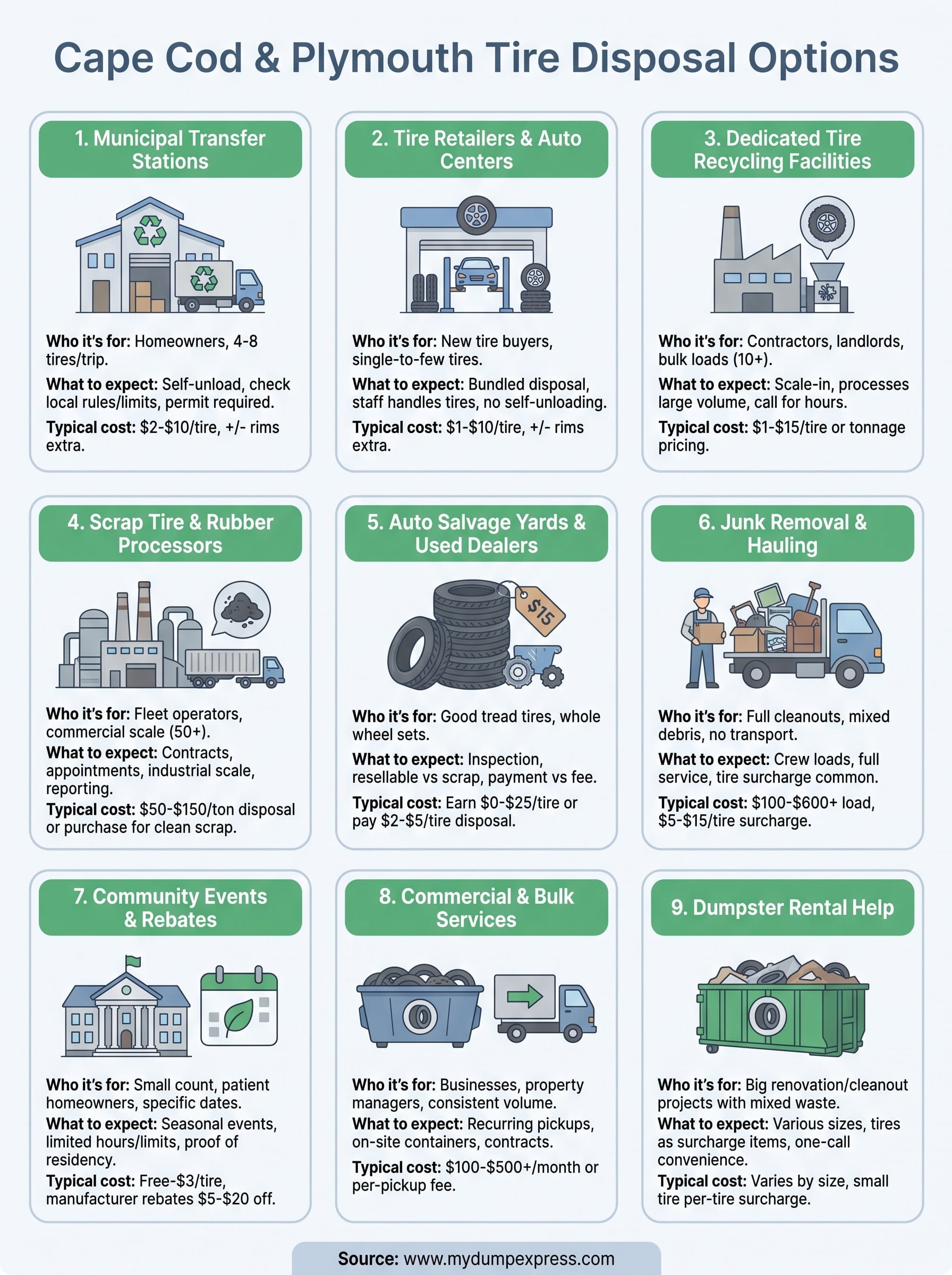
1. Municipal transfer stations and town recycling centers
Most Cape Cod and Plymouth residents start their search for tire recycling centers near me at the town transfer station, and that instinct is usually right. Nearly every municipality in Massachusetts operates some kind of solid waste facility, and many accept tires as part of their recycling programs. The catch is that rules vary wildly from one town to the next, so what works in Barnstable might not fly in Falmouth or Wareham.
How it works
Town transfer stations typically set aside a specific area for tires, separate from household trash and single-stream recycling. You drive in, check with the attendant, and unload the tires yourself at the designated spot. Some facilities require a transfer station sticker or permit tied to your address, which means you’ll need proof of residency before they’ll even let you through the gate. Others post tire limits, such as four tires per visit or per year, and charge per-tire fees that get added to your account or collected on the spot. A handful of towns bundle tire disposal into their regular sticker program, but that’s becoming less common as disposal costs climb for municipalities.
If you don’t confirm your town’s tire rules before loading the truck, you risk showing up to a facility that won’t take them.
Who it’s for
This option suits homeowners with a small number of tires, usually four to eight, from a routine tire swap or a garage cleanout. It also works well if you’re already a permit holder who visits the transfer station regularly for yard waste or bulky items, since you can knock out tire disposal in the same trip. Contractors and anyone with rims still attached, commercial-grade tires, or a large stack from a fleet vehicle usually find these facilities less practical, since per-tire limits and stricter rules on tire type often apply.
Cost and what to expect
Pricing depends entirely on your town, and the range across the region is wide enough that it’s worth calling ahead or checking your municipality’s website before you go. Here’s a general sense of what to expect:
| Factor | Typical Range |
|---|---|
| Cost per passenger tire | $2 to $5 |
| Cost per truck or SUV tire | $5 to $10 |
| Tires with rims | Often $2 to $5 more per tire |
| Annual or per-visit limit | 4 to 10 tires common |
| Permit or sticker required | Yes, in most towns |
Expect to pay in cash or check at many facilities, since not all transfer stations accept cards. Hours are limited too, often just a few days a week and closed on Sundays or holidays, so plan your trip around the posted schedule rather than assuming you can drop off tires whenever it’s convenient. If you’re outside your home town’s service area, most transfer stations flat-out refuse tires from non-residents, which is a common frustration for people who searched tire disposal near me expecting any nearby facility to work. Calling your town’s Department of Public Works before you drive over is the fastest way to confirm current fees, limits, and whether rims are accepted, since these details change more often than most residents expect.
2. Tire retailers and auto service centers
Buying new tires often solves your disposal problem automatically, since most shops fold the old set into the transaction without you having to ask. If you’re not buying anything and just need to get rid of a few tires, plenty of auto service centers still take drop-offs for a modest fee, making this one of the more convenient answers to searching for a tire disposal facility near me.
How it works
Retailers like tire shops and full-service garages are set up to handle tire disposal because they already have relationships with recyclers who pick up in bulk. When you buy new tires, the shop typically removes your old ones during installation and charges a small disposal fee per tire, sometimes bundled into the total price so you barely notice it. If you’re not purchasing tires there, call ahead and ask if they accept walk-in drop-offs, since policies differ from location to location and some shops only take tires purchased from them originally. Either way, you’re not doing the unloading yourself. Staff handle the tires, which is a real advantage if you’re dealing with heavy truck tires or rims you’d rather not wrestle into a bin.
Who it’s for
This path fits homeowners and commercial drivers replacing worn tires who want disposal handled in the same visit, without a second stop at a transfer station. It also works well for anyone with just one to four tires, since most shops aren’t equipped to process a full trailer load from a fleet or construction site. If you’re clearing out a stockpile from a past project rather than swapping tires you’re currently driving on, a dedicated recycling facility or bulk hauler will likely serve you better.
Cost and what to expect
Buying new tires almost always beats a standalone drop-off fee, since disposal gets bundled into the purchase instead of charged separately.
Expect the following general pricing when tire retailers handle disposal:
| Scenario | Typical Cost |
|---|---|
| Disposal fee with new tire purchase | $1 to $5 per tire |
| Drop-off without purchase | $3 to $10 per tire |
| Tires with rims | Often an added $2 to $5 |
| Bulk drop-off (5+ tires) | Some shops decline or charge more |
Most shops process payment right at checkout, so there’s no separate trip or paperwork. Just confirm the fee before you commit, since a few garages quote disposal costs only after the work is done, which can catch drivers off guard if they weren’t expecting the added line item.
3. Dedicated tire recycling facilities
Some operations exist purely to process tires at scale, and they’re often the best answer when a transfer station’s per-visit limit or a tire shop’s small-batch policy won’t cut it. These dedicated tire recycling facilities specialize in breaking rubber down into reusable material, and they’re built to handle volume in a way general-purpose waste sites aren’t.
How it works
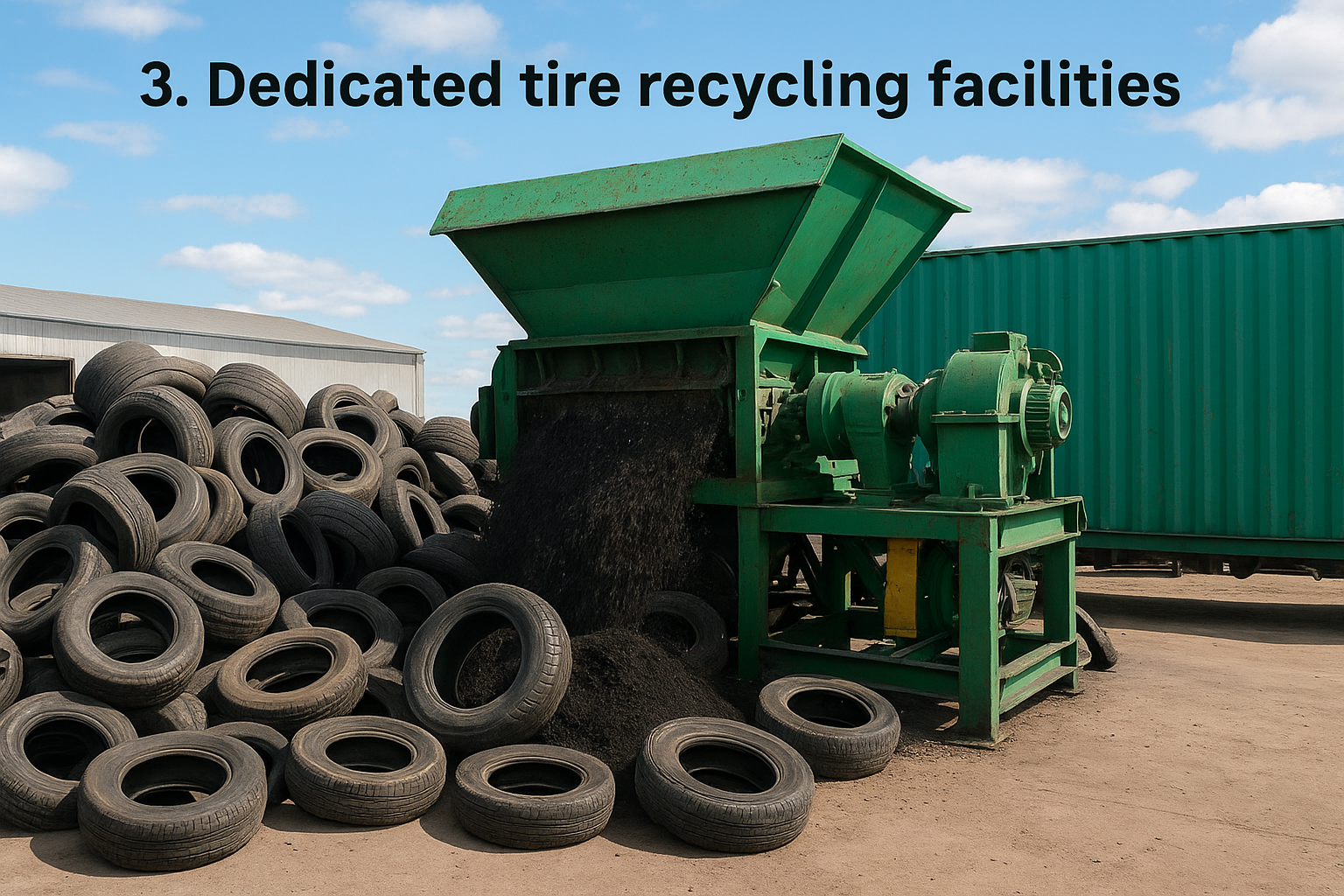
A dedicated facility takes tires in bulk and runs them through shredding or grinding equipment that turns rubber into crumb rubber, mulch, or feedstock for other products like playground surfacing and asphalt additives. You typically drive up to a designated bay, and staff weigh your load before directing you to unload. Larger facilities have scales built into the entrance so pricing is based on tonnage rather than a flat per-tire count, which matters if you’re bringing a mixed load of passenger and truck tires. Most locations post their accepted materials clearly, since some won’t take tires still mounted on rims or tires contaminated with debris from a job site. Calling ahead to confirm hours and current pricing saves a wasted trip, since these facilities often serve a wider region than a single town and get busier during peak renovation season.
A dedicated tire recycling facility is the right call once your load outgrows what a transfer station or tire shop will accept.
Who it’s for
Homeowners rarely need this option unless they’ve accumulated a large stash, ten or more tires, from years of storing old sets in a garage or shed. Contractors, landlords clearing multiple units, and anyone managing a property cleanup with a mixed pile of tires benefit more directly, since these facilities are built for exactly that kind of volume. If you’re searching for where to recycle tires near me because your local transfer station turned you away over quantity limits, a dedicated facility is usually the next logical stop.
Cost and what to expect
Pricing structures differ from the flat per-tire fees you’ll see at municipal sites:
| Factor | Typical Range |
|---|---|
| Passenger tire (no rim) | $1 to $3 per tire |
| Truck or oversized tire | $5 to $15 per tire |
| Bulk/tonnage pricing | Often cheaper per tire at volume |
| Rim removal fee | $1 to $3 extra per tire |
Most facilities accept cash or card, and larger operations may require an appointment for loads over a certain size. Expect faster processing than a town facility, since this is their core business rather than a side service.
4. Scrap tire and rubber processors
Scrap tire and rubber processors sit one level up from the dedicated recycling facilities covered above. Instead of serving walk-in customers with a handful of tires, these operations buy and process scrap rubber in massive quantities, often supplying material to asphalt plants, cement kilns, and manufacturers who use tire-derived fuel or crumb rubber as raw input. If you searched for a scrap tire processor near me because you’re managing a genuinely large volume, this is the tier built for that scale.
How it works
Processors typically work through contracts rather than casual drop-offs, though some accept smaller loads if you call ahead. Trucks deliver tires by the pallet or trailer load, and material gets weighed on industrial scales before it’s fed into shredders capable of processing thousands of tires a day. Output gets sold onward as tire-derived aggregate, fuel pellets, or rubber crumb, which is why these facilities care more about consistent volume than individual tire condition. Most require you to schedule delivery in advance, and some only work with commercial accounts that have an established relationship rather than one-time visitors.
Scrap tire processors are built for tonnage, not a trunk full of tires from a garage cleanout.
Who it’s for
This option makes sense for fleet operators, tire shops disposing of accumulated stock, demolition contractors, and businesses generating scrap rubber as a byproduct of their work. Homeowners almost never need this route. If your pile amounts to fewer than fifty tires, you’ll get turned away or told to use a smaller facility instead, since the logistics of scheduling a scale-in delivery aren’t worth it for a small load.
Cost and what to expect
Pricing here often flips compared to consumer-facing options. Large processors sometimes pay for clean, sorted scrap rubber rather than charging a disposal fee, especially when market demand for tire-derived fuel is strong.
| Factor | Typical Range |
|---|---|
| Minimum load size | Often 50+ tires or a full trailer |
| Sorted, clean scrap | May be purchased, not charged |
| Mixed/contaminated loads | $50 to $150 per ton disposal fee |
| Scheduling | Appointment or contract required |
Expect paperwork tracking weight and material type, since many processors report tonnage for regulatory or resale purposes. Casual walk-ins without an appointment usually get redirected elsewhere.
5. Auto salvage yards and used tire dealers
Salvage yards and used tire dealers take a different approach than the recyclers covered above, since they’re often looking to resell what still has tread life rather than shred everything into raw material. If your tires still hold decent tread, this route can put a few dollars back in your pocket instead of costing you a disposal fee, which makes it worth checking before you write off a set as scrap.
How it works
Used tire dealers inspect each tire for tread depth, sidewall damage, and overall wear before deciding whether it’s resellable. Tires that pass inspection get cleaned, sometimes patched, and sold at a discount to budget-conscious drivers. Anything that fails inspection, whether it’s dry rot, a bulge, or tread below legal minimums, gets set aside for scrap and typically routed to a recycler the dealer already works with. Salvage yards operate similarly but usually deal with tires still mounted on rims pulled from wrecked vehicles, so they’ll often buy the whole wheel assembly rather than just the tire. Bringing tires in clean and dry speeds up the inspection process, since grimy or waterlogged tires are harder to evaluate on the spot.
Tires with usable tread are worth checking against a used tire dealer before you assume they’re only good for scrap.
Who it’s for
This option fits homeowners with tires still in decent shape, maybe pulled off a car during an upgrade or found while cleaning out a garage, who’d rather sell than pay a disposal fee. It also works for anyone who bought a used vehicle with tires they don’t plan to keep, since salvage yards are used to processing that exact scenario. If your tires are cracked, flat-spotted, or clearly past their usable life, skip this route entirely and head straight to a recycling facility instead, since dealers will just reject the load and send you elsewhere.
Cost and what to expect
Pricing swings based on tire condition, and unlike most other options on this list, you might actually walk away with cash:
| Scenario | Typical Outcome |
|---|---|
| Good tread, no damage | $5 to $25 paid per tire |
| Moderate wear, resellable | $0 to $10 paid per tire |
| Poor condition, scrap only | $2 to $5 disposal fee per tire |
| Tires with rims (salvage) | Often bought as a set |
Bring tires in yourself for inspection, since most dealers won’t quote a price sight unseen or over the phone. Expect a quick visual check on the spot, with payment or fees settled immediately rather than billed later.
6. Junk removal and hauling companies
Sometimes the tires are just one piece of a much bigger mess. If you’re clearing a garage, a rental property, or a job site and tires are mixed in with furniture, scrap wood, and general debris, calling a junk removal company often makes more sense than sorting everything into separate disposal streams yourself. This option trades a lower per-tire cost for the convenience of not touching the pile at all.
How it works
Most junk hauling outfits send a crew that loads everything into a truck, then handles disposal on the back end, routing tires to a recycler and everything else to the appropriate landfill or donation center. You typically get a quote based on how much space your junk takes up in the truck, sometimes called a "load size" estimate, rather than an itemized breakdown per material type. Some companies charge extra per tire on top of the general hauling fee, since tires require separate handling and drop-off fees that regular trash doesn’t. Ask upfront whether tires are included in the quoted price or billed separately, since this detail varies by company and catches people off guard when the final invoice arrives.
Junk removal saves you the driving and unloading, but you’re paying for that convenience, not for the cheapest possible tire disposal.
Who it’s for
This route suits homeowners and property managers dealing with a full cleanout rather than just tires, especially if the job involves heavy or awkward items you don’t want to load yourself. It also fits people without a truck or trailer, since the crew brings their own vehicle and does the physical labor. If tires are your only item, this is rarely the cheapest path. A transfer station or tire retailer will almost always beat a hauling company’s price for tires alone.
Cost and what to expect
| Scenario | Typical Cost |
|---|---|
| Tires bundled into a full truckload | $100 to $600+ depending on volume |
| Per-tire surcharge added to quote | $5 to $15 per tire |
| Tires-only pickup (minimum fee) | Often $75 to $150 minimum |
| Same-day or next-day scheduling | Usually available for a fee |
Get a written quote before the crew arrives, and confirm whether tire surcharges are already factored in. Most companies accept cash or card on-site once the job is done.
7. Community collection events and manufacturer rebates
Once or twice a year, towns and civic groups across Cape Cod and Plymouth run community collection events built specifically for hard-to-recycle items like tires, electronics, and paint. Pair that with occasional manufacturer rebate programs from tire makers, and you’ve got a route that costs little to nothing if your timing lines up with the calendar.
How it works
Hosted collection events usually pop up in spring or fall, often tied to Earth Day or a town’s household hazardous waste day, and get announced through a municipal newsletter, town website, or local Facebook group. You show up during a narrow window, sometimes just a single Saturday, and volunteers or contracted haulers direct you where to unload. Manufacturer rebates work differently: brands occasionally run promotions where you mail in proof of an old tire’s disposal, or trade in a set at a participating retailer, in exchange for a discount on new purchases. Neither option runs continuously, so checking local event calendars ahead of time matters more here than with any other disposal method on this list.
A community collection event can mean free tire disposal, but only if you catch it while it’s actually running.
Who it’s for
This path fits homeowners with a small number of tires who aren’t in a rush and don’t mind waiting for the next scheduled event. It’s a good fit if you’re already planning to attend for other household hazardous waste anyway, since tires often get grouped into the same drop-off. Anyone needing disposal this week, or managing more than a handful of tires, should skip ahead to a transfer station or dedicated facility instead, since these events typically cap participation per household.
Cost and what to expect
| Factor | Typical Range |
|---|---|
| Community event drop-off | Often free or $1 to $3 per tire |
| Manufacturer rebate value | $5 to $20 off new tire purchase |
| Frequency | Usually one to two events per year |
| Per-household limit | Often 4 to 8 tires |
Bring proof of residency if the event is town-sponsored, since many restrict participation to local addresses. Rebates usually require saving a receipt or submitting a form within a set deadline, so don’t wait weeks to file the paperwork after your purchase.
8. Commercial and bulk tire recycling services
Businesses that generate tire waste as a regular part of operations, not a one-time cleanout, need a different setup than anything covered so far. Commercial and bulk tire recycling services build ongoing pickup schedules into a client’s operations, which is a different relationship than a single drop-off visit. Property management companies, fleet operators, and multi-location tire shops fall into this category, since their volume never really stops.
How it works
Providers in this space typically set up a recurring pickup schedule, whether that’s weekly, monthly, or triggered by a call once a storage bin fills up. Instead of you hauling anything anywhere, a truck comes to your site, weighs or counts the load, and takes it directly to a processing partner. Many providers supply an on-site collection container so tires don’t pile up loose in a lot or garage bay between pickups. Contracts often lock in pricing for a set term, which protects businesses from the swings you’d see calling around for one-off quotes. Some services also handle the paperwork tracking tonnage and disposal method, which matters for businesses that need documentation for environmental compliance or corporate reporting.
A recurring pickup contract only pays off once your volume is steady enough to justify the commitment.
Who it’s for
This option fits fleet managers, multi-bay repair shops, property managers overseeing several rental units, and any business generating tires faster than a monthly transfer station trip could keep up with. Homeowners and small contractors rarely need this tier. If your tire volume swings unpredictably from month to month, a contract built around consistent pickups won’t fit your situation as well as a pay-as-you-go facility would.
Cost and what to expect
Expect quotes built around contract terms rather than a flat per-tire rate:
| Factor | Typical Range |
|---|---|
| Monthly service contract | $100 to $500+ depending on volume |
| Per-pickup fee (no contract) | $75 to $250 per visit |
| On-site container rental | Often included or $20 to $50/month |
| Compliance reporting | Sometimes included, sometimes an add-on |
Getting multiple quotes matters here, since pricing depends heavily on pickup frequency, distance from a processing facility, and whether you need documentation. Ask providers directly what’s bundled into the monthly rate before signing anything.
9. Dumpster rental help for your bigger cleanup project
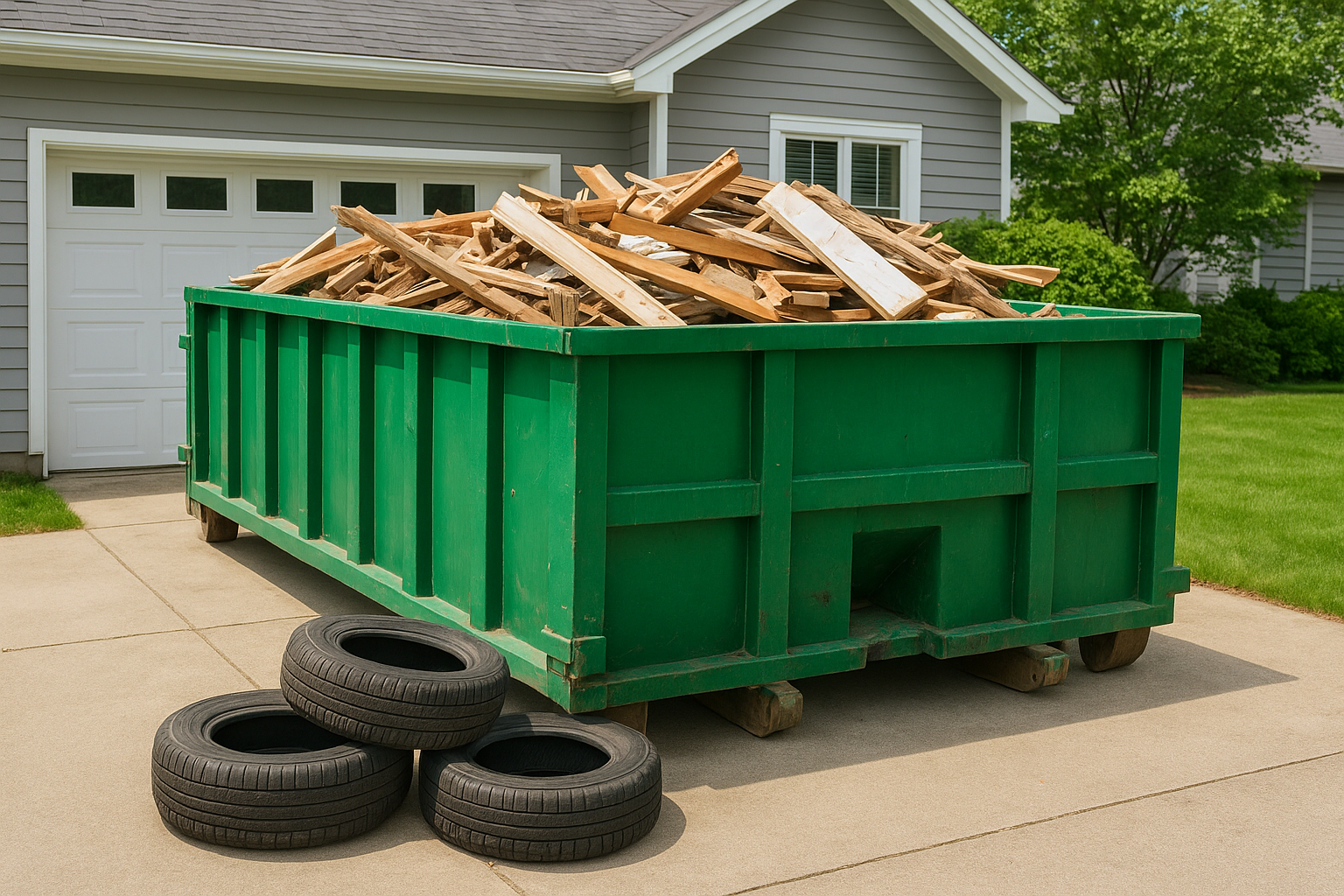
Sometimes tires are the smallest part of a much bigger job, a renovation that leaves behind drywall and lumber, a full garage cleanout, or a rental property turnover with years of accumulated junk. When that’s the case, renting a dumpster for the bulk of the debris while routing tires to one of the disposal options above often saves the most time and money overall. Dump Express serves Cape Cod and Plymouth with four dumpster sizes built for exactly this kind of mixed cleanup, which makes this a practical answer even for readers who started out searching tire recycling centers near me and realized their project is bigger than a few tires.
How it works
Ordering a dumpster works differently than any tire-specific option on this list, since you’re solving for volume and debris variety rather than tires alone. You pick a size based on your project, get it delivered to your driveway or job site, fill it over your rental period, and schedule pickup once you’re done. Most dumpster rental companies, including Dump Express, list tires as a restricted or surcharge item rather than a flatly banned one, since tires take up landfill space differently than compacted household waste. That means a handful of tires mixed into a renovation dumpster usually isn’t a dealbreaker, but a truckload of tires alone isn’t what a dumpster is built for.
A dumpster handles the bulk of your cleanup debris; tires almost always need their own line item, whether that’s a surcharge or a separate trip.
Who it’s for
This option fits homeowners and contractors managing a renovation, cleanout, or job site where tires are one piece of a larger debris pile rather than the whole project. It also suits anyone who’d rather make one call and get one delivery instead of coordinating separate trips to a transfer station, a tire shop, and a junk hauler. If tires are truly your only item, a dedicated tire recycling facility or your town transfer station will cost less and handle the job faster than ordering a dumpster just for that.
Cost and what to expect
| Dumpster Size | Typical Use | Relative Cost |
|---|---|---|
| 5-yard | Small cleanouts, minor projects | Lowest |
| 10-yard | Garage cleanout, small renovation | Low-mid |
| 15-yard | Larger renovation, moderate debris | Mid-high |
| 20-yard | Major renovation, construction | Highest |
Pricing on Dump Express is town-specific and transparent, so you see your actual rate before booking instead of a vague estimate. Tires typically add a small per-tire surcharge if you include them in the load, so ask about that upfront when you book. Same-day and next-day delivery are available across most of Cape Cod and Plymouth, which helps when a project timeline is tighter than the tire pile alone would suggest.
Finding the best fit for your old tires
Matching your tire pile to the right disposal option comes down to two questions: how many tires you have, and what else you’re clearing out at the same time. A handful of worn tires from a routine swap belongs at your town transfer station or the shop that just installed your new set. A garage full of tires accumulated over years points toward a dedicated recycling facility. And if tires are just one part of a renovation, cleanout, or job site full of other debris, trying to sort everything into separate trips wastes time you don’t have.
That’s where a dumpster rental earns its place on this list. One delivery handles the bulk of your project debris while you route tires to whichever option above fits your volume. If your Cape Cod or Plymouth cleanup involves more than a few tires, get a transparent quote from Dump Express and get the bigger job off your plate in one call.