
You have three tabs open, each with a different quote for what should be a simple dumpster rental, and none of the numbers seem to line up. That’s the reality of any dumpster rental price comparison: sizes get labeled differently, some companies bury fees until delivery day, and a quote for Hyannis rarely matches one for Plymouth. If you’re trying to figure out what you’ll actually pay before a truck shows up, you’re not overthinking it. You’re being smart.
This article breaks down real pricing by dumpster size, from a 5-yard cleanout box to a 20-yard construction container, and explains why the same size can cost noticeably more or less depending on your town, your hauler, and what’s riding in the load. You’ll see where hidden fees typically hide and how transparent pricing should actually look on a quote.
We’ll also walk through what drives cost swings between companies, so you can compare apples to apples instead of guessing. After 20+ years renting dumpsters across Cape Cod and Plymouth, we’ve seen every pricing trick in the book, and we’ll show you exactly what to expect for your project.
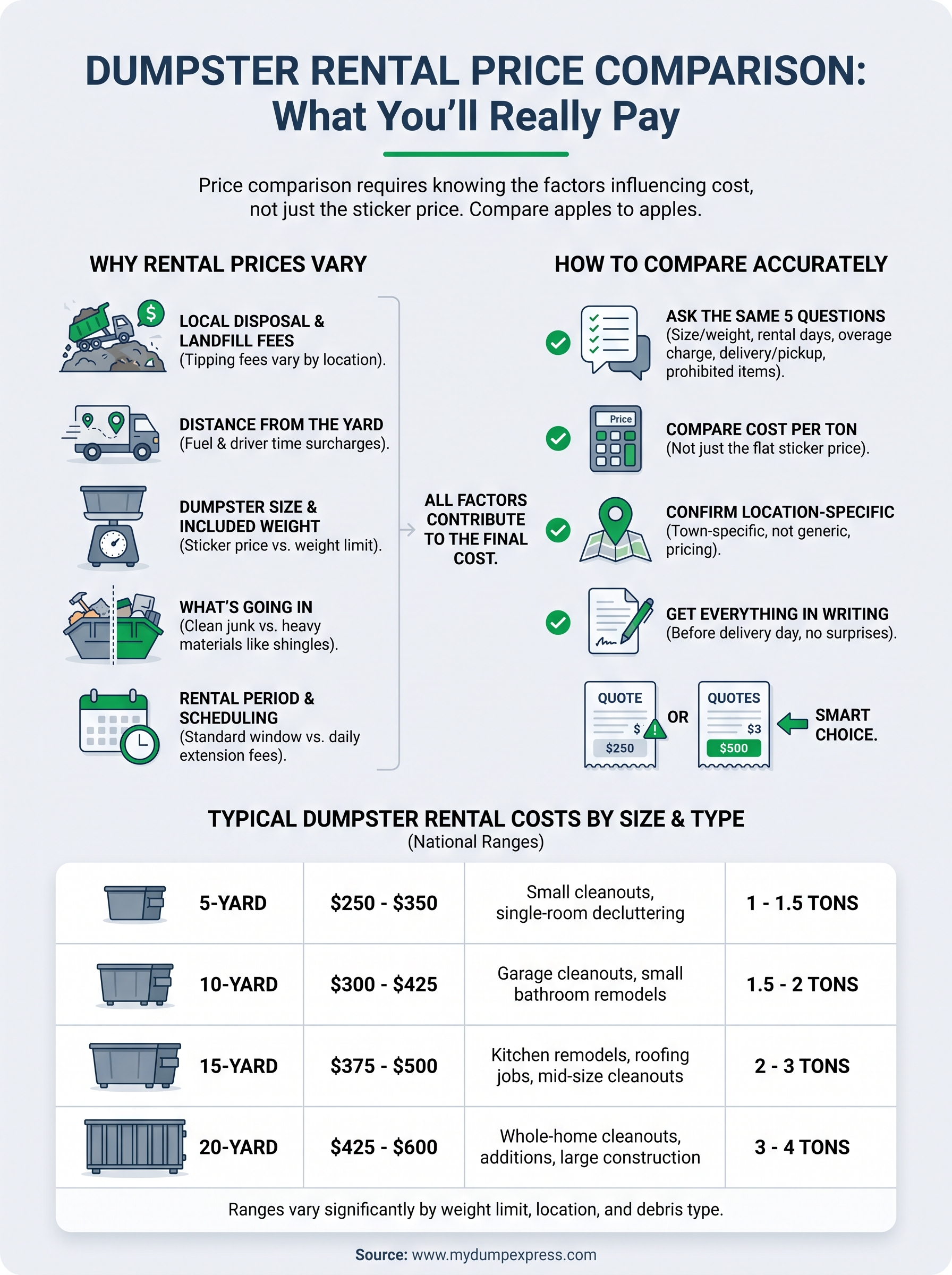
Why dumpster rental prices vary so widely
Ask five dumpster companies for a quote on the same project and you’ll likely get five different numbers, sometimes off by $150 or more for the exact same size container. That spread isn’t random. It comes down to a handful of factors that shift from town to town and company to company, and understanding them is the first step in any real dumpster rental price comparison.
Local disposal and landfill fees
Every hauler pays a tipping fee to dump loads at a transfer station or landfill, and those fees vary by county and even by facility. A company running loads to a facility with high per-ton fees has to build that cost into your quote, while one with a closer or cheaper disposal option can price lower without cutting corners. On Cape Cod and in Plymouth, this is a big reason why a quote for one town can run noticeably different from a quote for a town twenty minutes away, even from the same company.
Distance from the yard
Delivery trucks burn fuel and driver hours getting to your driveway and back. A company with a single yard covering a wide territory has to price in longer drives for far-flung addresses, sometimes as a flat delivery surcharge, sometimes baked quietly into the base rate. Companies running multiple yard locations across their service area can usually keep drive times short and prices more consistent, which is one reason local, multi-yard operators tend to beat single-yard regional players on price and turnaround.
Dumpster size and included weight
Size alone doesn’t explain price swings. What matters just as much is the weight allowance bundled into the rental. A 15-yard dumpster with a 2-ton limit and one with a 3-ton limit will carry very different price tags, and if you don’t check the fine print, you’ll compare two quotes that look similar but aren’t apples to apples at all.
The size on the label means nothing if you don’t know the weight limit that comes with it.
What’s going in the dumpster
Debris type changes pricing more than most people expect. Clean household junk costs less to dispose of than construction debris, and materials like shingles, concrete, or dirt often get charged by the ton rather than folded into a flat rate because they’re so heavy relative to their volume. A quote that doesn’t ask what you’re throwing away is a quote that hasn’t accounted for your actual cost.
Rental period and pickup scheduling
Most companies build a standard rental window, often 7 to 10 days, into their base price. Keep the dumpster longer and you may pay a daily extension fee. Companies that only schedule pickups around disposal facility business hours tend to have more predictable turnaround than ones promising pickup whenever, which sometimes means slower service disguised as flexibility.
Business model and overhead
Finally, how a company operates affects its pricing structure. Call-center-based operators dispatching to independent local haulers often add a layer of markup to cover their referral model. Locally owned companies with their own trucks, drivers, and yards can skip that middleman cost. This doesn’t automatically mean local is cheaper on every quote, but it does explain why national platforms and local outfits rarely land on the same number for an identical job.
Once you see these factors laid out, the wide range of quotes stops looking confusing and starts looking like exactly what it is: different companies solving the same problem with different cost structures.
How to compare dumpster rental quotes accurately
Once you know why prices swing, the next step is making sure you’re comparing the same thing across every quote you collect. Side-by-side pricing only works if each company answers the same set of questions, and most won’t volunteer the details unless you ask directly.
Ask the same five questions every time
Before you compare a single dollar figure, get these answers in writing or over the phone from every company on your list:
- What size dumpster, in cubic yards, and what’s the actual weight limit included?
- How many days does the rental period cover before extension fees start?
- What’s the per-ton overage charge if you go over the weight limit?
- Are delivery and pickup included, or charged separately based on distance?
- What items are prohibited, and is there a surcharge list for things like mattresses or tires?
Without these five answers, a quote is just a guess dressed up as a price.
Compare cost per ton, not just the sticker price
A $350 quote with a 1-ton limit can end up costing more than a $420 quote with a 3-ton limit, especially if your project involves heavy debris like shingles or old furniture. Divide the total price by the included tonnage to get a real cost-per-ton figure, then compare that number across quotes instead of the flat rate alone. This single step catches more pricing tricks than anything else on this list.
Comparing sticker prices without checking the weight limit is how homeowners end up paying twice.
Confirm the quote is location-specific
A generic quote pulled from a national call center often doesn’t reflect your actual town’s disposal fees or drive distance. Ask whether the price you’re given is specific to your address, or a regional estimate that could shift once a local hauler gets assigned. Companies with town-specific pricing posted upfront, rather than a one-size-fits-all number you have to call in for, tend to hold to their quotes more reliably.
Get everything in writing before delivery day
Verbal quotes have a way of growing new fees once the truck shows up. Request a written confirmation that spells out the size, weight limit, rental period, and any surcharge terms before you commit, so there’s nothing left to negotiate on delivery morning.
Dumpster rental costs by size and type
Size drives most of the price difference you’ll see across quotes, but it doesn’t tell the whole story on its own. Two companies can list the same 15-yard container at wildly different rates once you factor in weight limits, rental length, and what kind of debris you’re hauling. The table below shows typical national price ranges by size, based on standard residential rental terms, so you have a baseline before you start collecting quotes.
| Size | Typical Price Range | Best For | Typical Weight Limit |
|---|---|---|---|
| 5-yard | $450 – $550 | Small cleanouts, single-room decluttering | 1/2 ton |
| 10-yard | $550 – $650 | Garage cleanouts, small bathroom remodels | 1 tons |
| 15-yard | $650 – $750 | Kitchen remodels, roofing jobs, mid-size cleanouts | 1 – 1.5 tons |
| 20-yard | $700 – $750 | Whole-home cleanouts, additions, larger construction debris | 1 – 1.5 tons |
Why the ranges are so wide
Each size above has a $100 to $175 spread, and that gap almost always comes down to weight allowance and disposal fees baked into the base price. A 20-yard quote at the low end of that range likely comes with a tighter tonnage limit, while the high end usually includes more weight before overage charges kick in.
Two dumpsters can be the exact same size and still cost $150 apart once you check what’s actually included.
Matching size to project type
Getting the size right matters as much as the price itself, because ordering too small means a second haul, and ordering too large means paying for capacity you never use. Household cleanouts and small decluttering jobs almost always fit in a 5 or 10-yard container. Renovation projects involving flooring, cabinets, or drywall usually land in the 15-yard range. Construction and demolition debris, especially anything involving concrete, shingles, or dirt, tends to push toward a 20-yard container with a higher weight allowance, since that material is heavy relative to its volume.
Type of debris changes the math
Mixed household junk and clean construction debris rarely cost the same, even in an identical size container. Heavier material categories, like roofing shingles or concrete, often get priced separately by the ton rather than folded into a flat rate, which is why a contractor’s quote for a demolition job can look nothing like a homeowner’s quote for the same size box.
Hidden fees that can skew your price comparison
A quote that looks like a bargain on the phone can turn into the priciest option once the invoice arrives. Hidden fees are the single biggest reason two seemingly identical dumpster rentals end up costing wildly different amounts, and most of them never show up until delivery day or later.
The usual suspects
Before you sign off on any quote, check whether these charges are already included or waiting to surprise you:
- Overweight fees: charged per ton once you cross the included weight limit, often $250 to $300 per ton
- Extended rental fees: a daily rate that kicks in once you pass the standard 7 to 10 day window
- Trip fees or long-carry charges: added when the truck can’t park close to the dumpster’s final spot
- Prohibited item surcharges: flat penalties for mattresses, tires, paint, or appliances with refrigerants
- Environmental or fuel fees: a percentage tacked onto the base price, sometimes disclosed only in fine print
- Restocking or cancellation fees: charged if you cancel after a truck has already been dispatched
The lowest quote on paper usually isn’t the lowest price once every fee gets added back in.
Why these fees are so easy to miss
Companies that quote a low base rate often make up the difference through these add-ons, and since each fee looks small on its own, the total impact is easy to underestimate until you’re comparing final invoices instead of initial quotes. Overweight fees do the most damage, since a single ton over the limit can add more to your bill than the entire delivery fee. Prohibited item surcharges catch people off guard too, especially with mattresses and box springs, since most haulers treat these as separate charges rather than folding them into the flat rate. Trip fees hit hardest on properties with long driveways, tight turns, or overhead wires that keep the truck from parking close.
How to fee-proof your comparison
Ask every company for a full fee schedule before you book, not just the base price. Request the prohibited items list and confirm whether anything on it applies to your project, since a couch cushion stuffed with foam or an old propane tank can trigger a surcharge you didn’t budget for. Finally, ask directly whether the quote includes fuel or environmental charges, since these get added as a percentage far more often than companies advertise upfront.
What dumpster rental pricing looks like on Cape Cod
Cape Cod adds a layer of complexity that flat national averages can’t capture. Seasonal traffic, causeway bottlenecks onto the peninsula, and a patchwork of 40-plus towns each with their own disposal rules mean the same 15-yard container can price differently in Falmouth than it does in Provincetown, even on the same week.
Why local geography drives the number
Because Cape Cod is a peninsula, every truck that heads out toward the outer Cape burns more time and fuel than one staying closer to the bridges. Companies running a single yard location near the bridges often pass that extra drive time along as a delivery surcharge for towns further out. Operators with multiple yard locations spread across the Cape and into Plymouth can shorten that drive for most addresses, which keeps pricing more consistent whether you’re in Bourne or Chatham.
On a peninsula, drive time isn’t a minor detail. It’s baked into every quote you get.
Town-specific pricing beats regional guessing
A quote based on “Cape Cod pricing” in general almost always misses the mark, since disposal fees and travel distance shift block by block near town lines. Posted, town-specific pricing lets you see your actual number before you call anyone, rather than getting a regional estimate that changes once a driver gets assigned to your address.
| Region | Typical Factor Affecting Price |
|---|---|
| Upper Cape (Bourne, Falmouth) | Closer to yard locations, shorter drive times |
| Mid Cape (Hyannis, Barnstable) | Higher seasonal volume in summer months |
| Outer Cape (Orleans, Wellfleet, Provincetown) | Longer hauls, fewer nearby disposal options |
| Plymouth area | Separate tipping fee structure from Cape facilities |
What to expect in a real Cape Cod quote
Expect your quote to reflect the standard size-based ranges covered earlier, adjusted slightly for your specific town rather than a flat Cape-wide number. Seasonal demand also plays a role. Summer months bring more renovation and cleanout projects, which can tighten scheduling windows even when the base price stays the same. Reliable, seven-day-a-week delivery matters more here than in most markets, since a missed pickup window on a busy August weekend can stall a whole project.
Getting a price you can trust
A real dumpster rental price comparison isn’t about finding the lowest number on the page. It’s about knowing what that number actually includes before a truck pulls into your driveway. Weight limits, rental length, prohibited items, and your specific town all move the final price more than the size label ever will. Quotes that leave those details out aren’t cheaper, they’re just incomplete.
Run every quote through the questions in this guide, and you’ll spot the difference between transparent pricing and a number designed to look good over the phone. Compare cost per ton, confirm your town’s rate, and get the fee schedule in writing before you commit to anything.
If you’re ready to see what honest, town-specific pricing looks like for your project, get a quote from Dump Express and know exactly what you’ll pay before the truck ever shows up.