
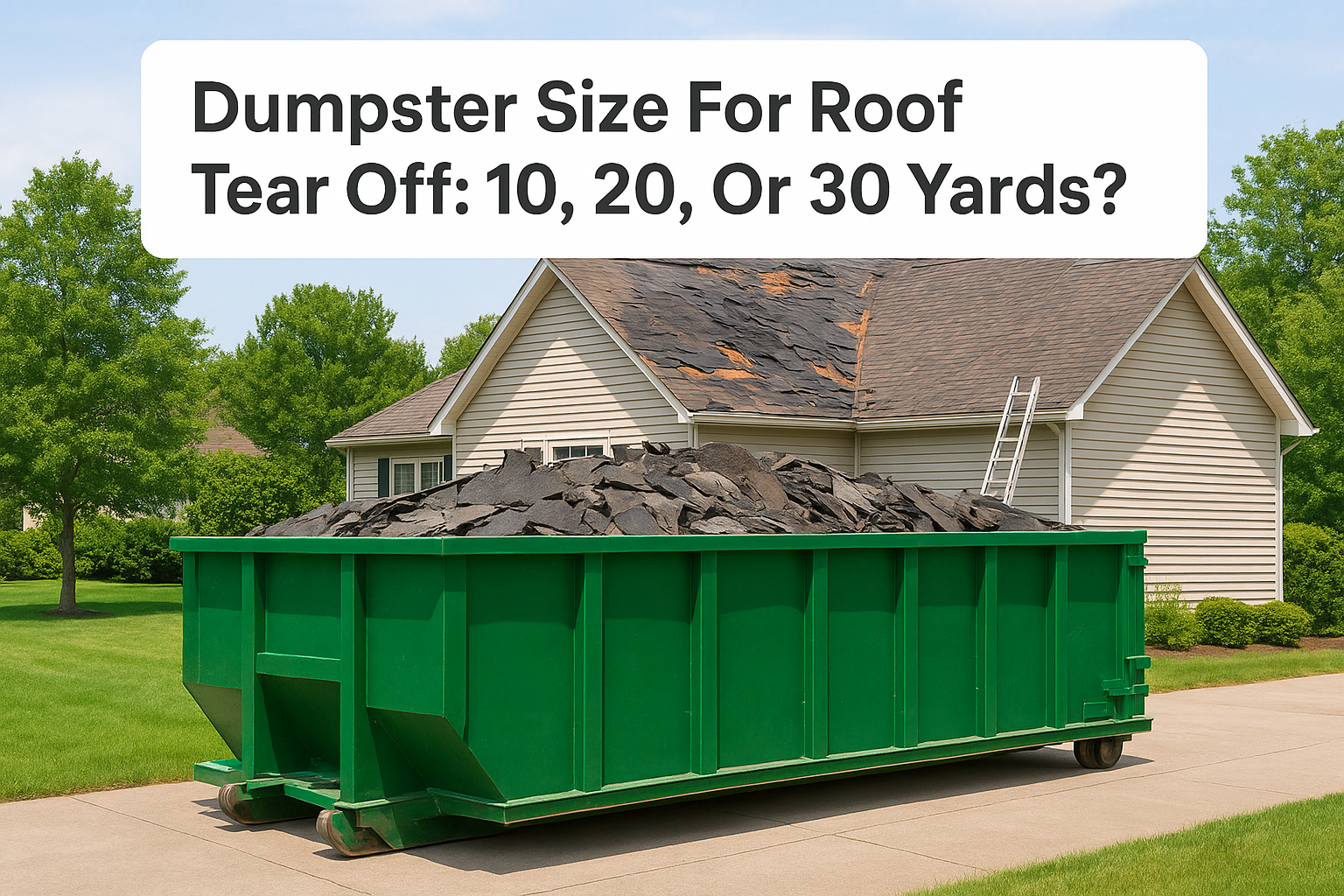
Picking the wrong dumpster size for a roof tear off is one of the most common (and expensive) mistakes homeowners and contractors make during a roofing project. Order too small and you’re paying for a second haul. Order too big and you’re wasting money on capacity you’ll never fill. Either way, it cuts into your budget.
The right size depends on a few straightforward factors: how many roofing squares your roof covers, how many layers of shingles are coming off, and the weight of the material. Once you know those numbers, the math is simple, and we’ll walk you through it. At Dump Express, we help homeowners and contractors across Cape Cod and Plymouth work through these decisions every day, so we know where people tend to get tripped up.
This guide breaks down when a 10-yard, 20-yard, or 30-yard dumpster makes sense for your tear off, how to estimate your debris volume, and what to watch out for before you book. By the end, you’ll know exactly what size fits your roof, no guesswork, no overspending.
What changes dumpster size for a roof tear off
Three factors drive every dumpster size for roof tear off decision: the square footage of your roof, how many layers of old shingles are coming off, and the weight of the material you’re loading. Get a handle on all three before you book, and you’ll avoid the two most common problems: overfilling a container or paying for a 30-yard bin when a 10-yard does the job fine.
Roof size in squares
Roofing contractors measure roof area in squares, where one square equals 100 square feet of roof surface. A standard cape-style home might cover 20 to 30 squares, while a larger colonial or a home with complex geometry can push past 40. Your total square count is the starting point for every calculation that follows.
The more squares your roof covers, the more debris you’ll generate, and your dumpster size needs to reflect that from the start.
Number of shingle layers
Many roofs have more than one layer of shingles, especially older homes where a second layer was added over the first instead of tearing down to the deck. If your contractor is removing two layers instead of one, you’re generating roughly twice the debris volume for the same roof size. That single factor alone can push you from a 10-yard to a 20-yard container.
Some older Cape Cod homes carry three layers, which is less common but not unusual on houses that have gone decades without a full tear off. Before you rent anything, ask your roofer to confirm the exact layer count so your estimate stays accurate.
Material type and weight
Standard asphalt shingles run heavy for their volume, averaging around 250 to 300 pounds per roofing square. If your roof includes denser materials, those numbers climb quickly. Here’s a quick reference for common roofing materials:
| Material | Approximate Weight Per Square |
|---|---|
| Asphalt shingles | 250 to 300 lbs |
| Wood shakes | 300 to 350 lbs |
| Slate or tile | 700 to 1,500 lbs |
Most dumpsters carry a weight limit, and going over it triggers overage charges. Knowing your material type before you book helps you pick a container with enough capacity, not just enough space.
Step 1. Estimate your roof in squares
Before you can pin down the right dumpster size for a roof tear off, you need a reliable square count. A roofing square equals 100 square feet of roof surface, and that unit is the foundation of every debris estimate you’ll make.
Measure your footprint first
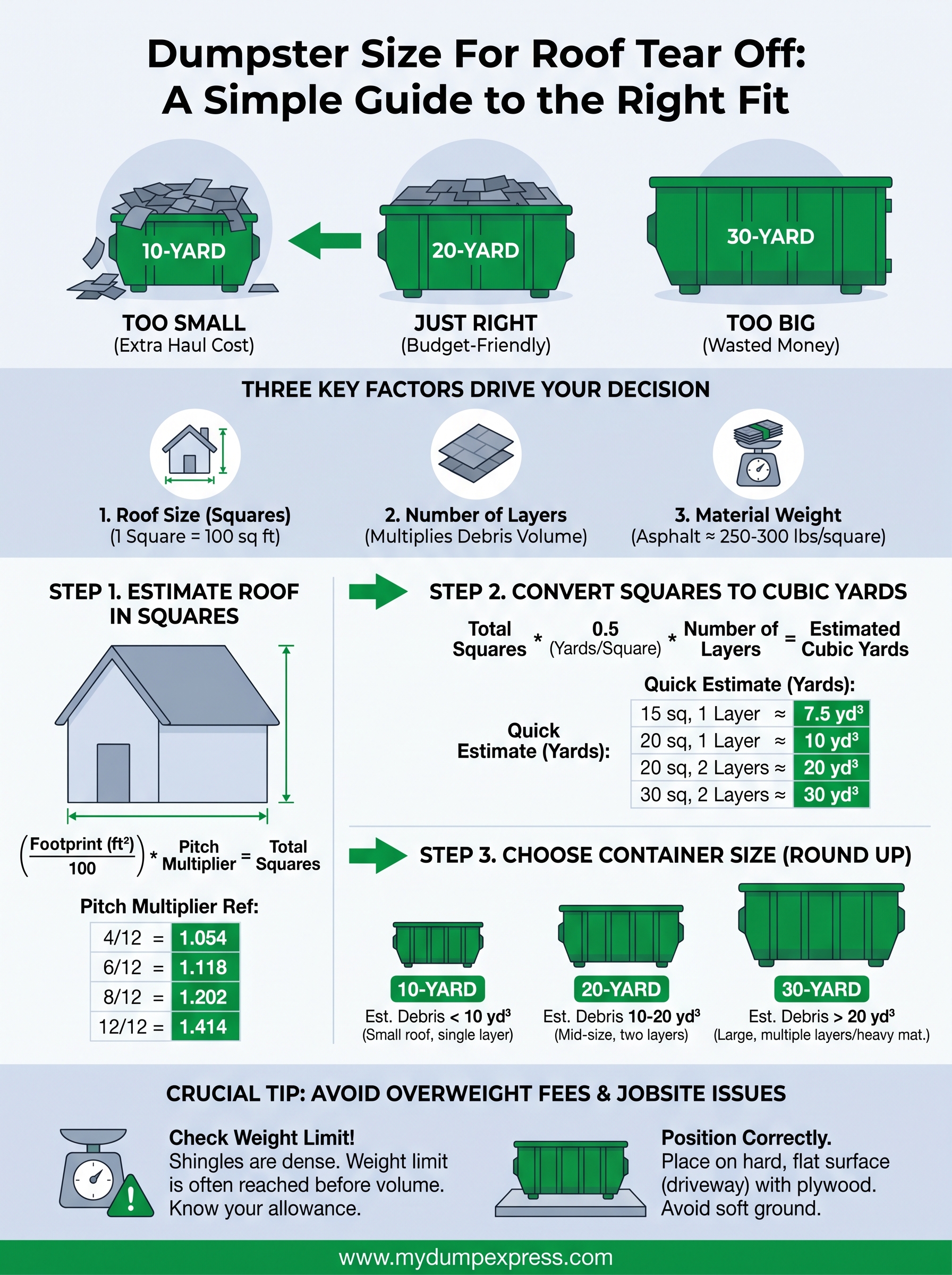
Start by measuring the ground-level footprint of your home in feet, then multiply length by width. A house that measures 40 feet by 30 feet has a 1,200 square foot footprint. Divide that number by 100 to get your starting square count, which in this case is 12 squares.
Your footprint measurement is always the starting point, but your actual roof area will run higher once you factor in slope.
Adjust for roof pitch
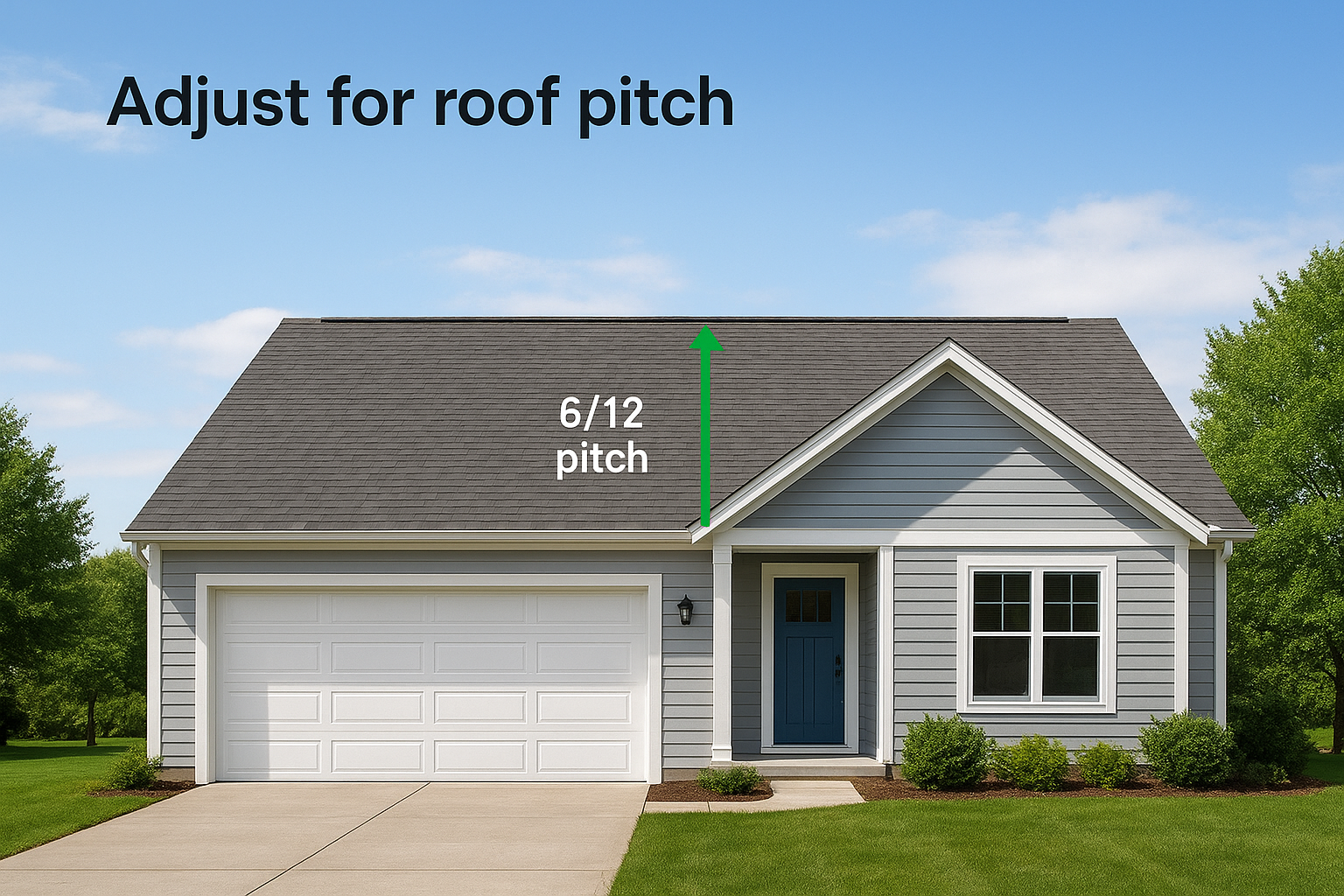
A flat roof uses roughly the same area as your footprint, but most pitched roofs cover more surface than the ground measurement suggests. A standard 6/12 pitch (six inches of rise for every 12 inches of run) adds about 12 percent more area. Use this multiplier table to adjust your number:
| Roof Pitch | Multiplier |
|---|---|
| 4/12 | 1.054 |
| 6/12 | 1.118 |
| 8/12 | 1.202 |
| 12/12 | 1.414 |
Multiply your footprint squares by the correct figure from that table to get your true roofing square count, and carry that number into every calculation going forward.
Step 2. Convert squares to dumpster yards
Once you have your true square count, the next step is converting that number into dumpster cubic yards. This is where your layer count and material type from the previous section feed directly into the math. A single layer of standard asphalt shingles produces roughly 0.5 cubic yards of debris per roofing square, and that ratio is your baseline for everything that follows.
The single-layer formula
Multiply your square count by 0.5 to get the approximate cubic yards you need for a single-layer tear off. A 20-square roof with one layer generates around 10 cubic yards of debris, which lands at the low end of a 10-yard container. Use this table as a quick reference:
| Roof Squares | Single Layer (cu. yds.) | Two Layers (cu. yds.) |
|---|---|---|
| 15 | 7.5 | 15 |
| 20 | 10 | 20 |
| 25 | 12.5 | 25 |
| 30 | 15 | 30 |
| 40 | 20 | 40 |
Always round up to the next container size rather than booking the exact volume, since debris rarely packs as neatly as the math suggests.
Adjusting for multiple layers
Each additional shingle layer multiplies your debris volume by the same factor. Two layers double your cubic yard estimate, so a 20-square roof with two layers needs roughly 20 cubic yards, shifting you from a 10-yard to a 20-yard unit. This is the single most common reason people underestimate their dumpster size for roof tear off projects.
If your roofer confirms three layers, multiply your baseline by three and book the next size up from that total to leave yourself a reasonable buffer.
Step 3. Choose 10, 20, or 30 yard plan
With your cubic yard estimate in hand, matching it to a specific container size is straightforward. Use the table below as your decision guide, and always round up when your estimate sits close to a size boundary.
| Estimated Debris (cu. yds.) | Recommended Container | Typical Scenario |
|---|---|---|
| Under 10 | 10-yard | Small roof, single layer, 15 to 20 squares |
| 10 to 20 | 20-yard | Mid-size roof or any two-layer job |
| Over 20 | 30-yard | Large roof, multiple layers, 30+ squares |
Booking the next size up costs less than paying for a second haul when the first container fills before the job finishes.
When a 10-yard works
A 10-yard container handles most small roofing jobs without issue. If your roof covers 20 squares or fewer with a single layer of standard asphalt shingles, a 10-yard unit gives you enough capacity without overpaying for space you won’t use. This size also suits targeted repairs where only one section of a larger roof is coming off.
When to step up to 20 or 30 yards
Two-layer tear offs on mid-size roofs almost always push past 10 cubic yards, making a 20-yard container the logical choice. For jobs involving 30 or more squares with multiple layers, or any roof covered in heavier material like slate or tile, a 30-yard unit is the correct dumpster size for roof tear off work at that scale. Before booking, confirm which sizes your rental company actually carries in your area, since availability varies by provider and location.
Avoid overweight fees and jobsite problems
Choosing the correct dumpster size for roof tear off work gets you most of the way there, but weight is the factor that catches people off guard. Most dumpsters carry a weight limit built into the rental price, and shingles are dense enough to hit that ceiling before the container looks anywhere near full. Crossing the limit triggers per-ton overage charges that add up fast on a multi-layer job.
Know your weight limit before you load
Ask your rental provider for the exact weight allowance on the container you book, not just the cubic yard capacity. Asphalt shingles run roughly 250 to 300 pounds per square, so a 20-square single-layer tear off generates around 5,000 to 6,000 pounds of material. Compare that against your container’s limit before the first shingle bundle lands in the bin.
If your debris weight is likely to exceed the container’s limit, book the next size up rather than paying overage fees after the fact.
| Roof Squares | Single Layer (lbs.) | Two Layers (lbs.) |
|---|---|---|
| 15 | 3,750 to 4,500 | 7,500 to 9,000 |
| 20 | 5,000 to 6,000 | 10,000 to 12,000 |
| 30 | 7,500 to 9,000 | 15,000 to 18,000 |
Position the container correctly
Place the dumpster on a hard, flat surface like a driveway or paved area rather than soft ground. Heavy shingle loads can cause containers to sink into grass or gravel, making pickup difficult and potentially damaging your property. Confirm these placement details with your rental company before delivery:
- Whether plywood boards are needed to protect your driveway surface under the container
- How much overhead clearance the delivery truck requires
- Whether a street permit is needed if the container will sit outside your property line
Ready to book the right size
You now have everything you need to pick the correct dumpster size for roof tear off work on your project. Start with your square count, multiply by your layer total, check that the estimated weight falls inside the container’s limit, and round up to the next size if your number sits near a boundary. Those four steps keep you from paying for a second haul or getting hit with overage charges mid-job.
Dump Express serves Cape Cod and Plymouth with dumpster options sized for roofing jobs of every scale, from a quick single-layer swap on a small cottage to a full three-layer tear off on a large colonial. Our local team will confirm the right size before you book and schedule delivery to fit your roofer’s timeline. Book your roofing dumpster with Dump Express and have the right container on-site before the first shingle comes off the deck.