
That old patio, driveway, or foundation isn’t going anywhere on its own, and figuring out how to dispose of broken concrete is more complicated than tossing it in your regular trash. Concrete is heavy, it’s often mixed with rebar or gravel, and most municipal pickup services won’t touch it. You’re left wondering whether to haul it yourself, call a hauler, or find somewhere that recycles it.
The short answer is that you have a handful of solid options: licensed landfills, construction and demolition recycling centers, junk removal crews, or a dumpster rental sized for concrete’s weight. Which one makes sense depends on how much material you’re dealing with, whether you can lift and load it yourself, and how fast you need it gone.
In this guide, we’ll walk through each disposal method, what it typically costs, and where concrete recycling actually beats the landfill. We’ll also cover weight limits and dumpster sizing for concrete specifically, since it behaves very differently from household junk once it’s loaded. If you’re on Cape Cod or in Plymouth, we’ll point out what local rules and facilities you should know before you start breaking anything up.
What to know before you dispose of broken concrete
Before you rent a dumpster or load up a truck, understand that broken concrete plays by different rules than regular construction debris. It’s classified as construction and demolition (C&D) debris in most towns, which means curbside trash pickup won’t take it and many transfer stations charge separate rates just for concrete. Skipping this step is how homeowners end up with a driveway’s worth of rubble and no legal way to get rid of it.
Weight changes everything
Concrete weighs roughly 150 pounds per cubic foot, which is why a dumpster that easily handles a house cleanout can hit its weight limit with only a quarter load of concrete. Most rental companies set strict tonnage caps on containers specifically because of this, and going over means extra fees per ton, not just a bigger bill for volume.
Concrete disposal is a weight problem first and a volume problem second.
Local rules matter more than you’d think
Every town handles construction debris differently. Some Cape Cod and Plymouth-area transfer stations accept clean concrete for a reduced fee if it’s separated from other materials, while others reject it outright and send you to a dedicated C&D facility. Calling ahead saves you a wasted trip with a truck bed full of rubble nobody will take.
Clean versus contaminated concrete
Recycling facilities distinguish between clean concrete, meaning no rebar, wire mesh, or attached materials like tile and wood, and mixed debris. Clean loads often qualify for lower disposal rates or even free drop-off at recycling centers that crush and resell the material as aggregate. If your concrete has embedded metal or is bonded to other demolition waste, plan on paying standard C&D rates instead.
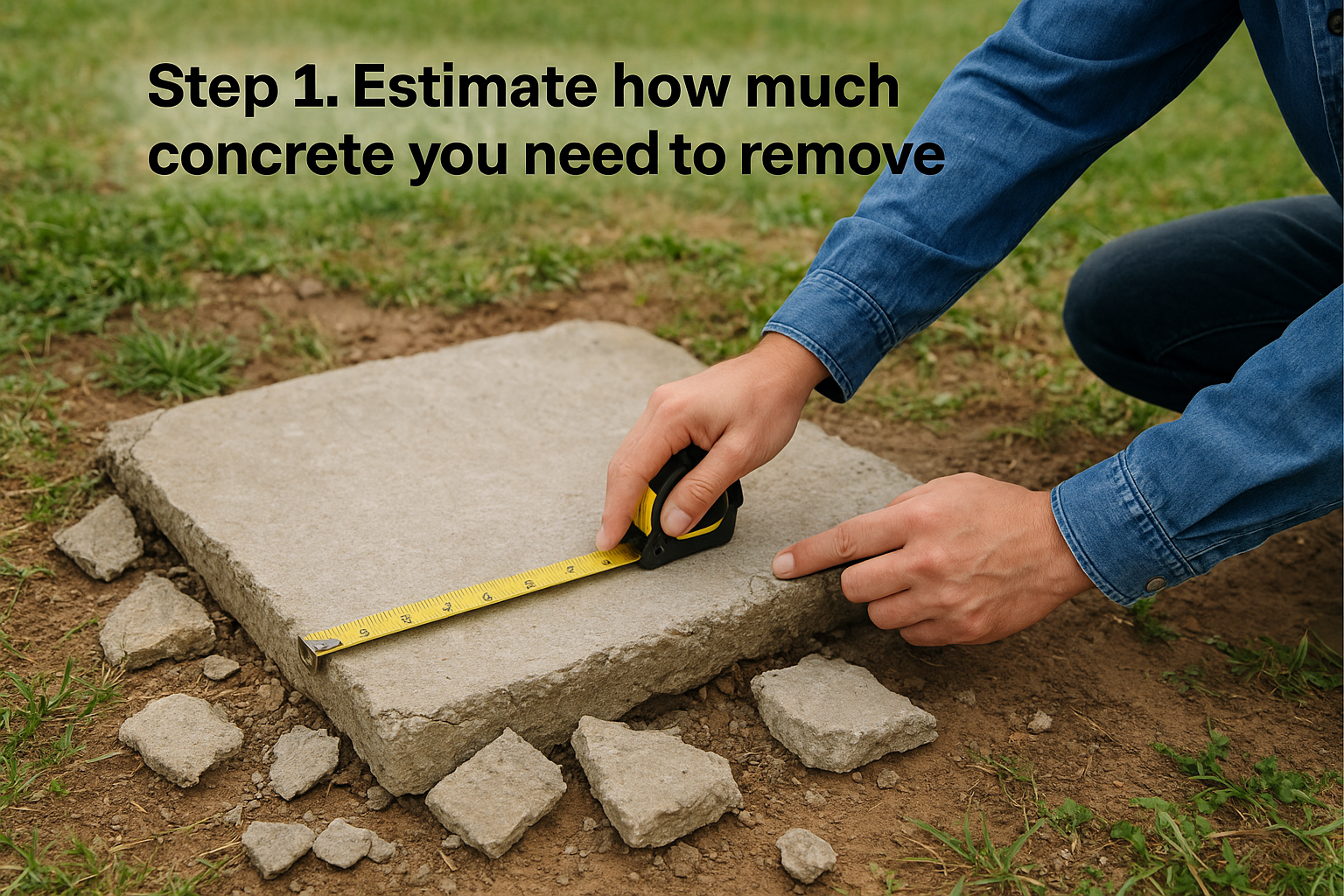
Step 1. Estimate how much concrete you need to remove
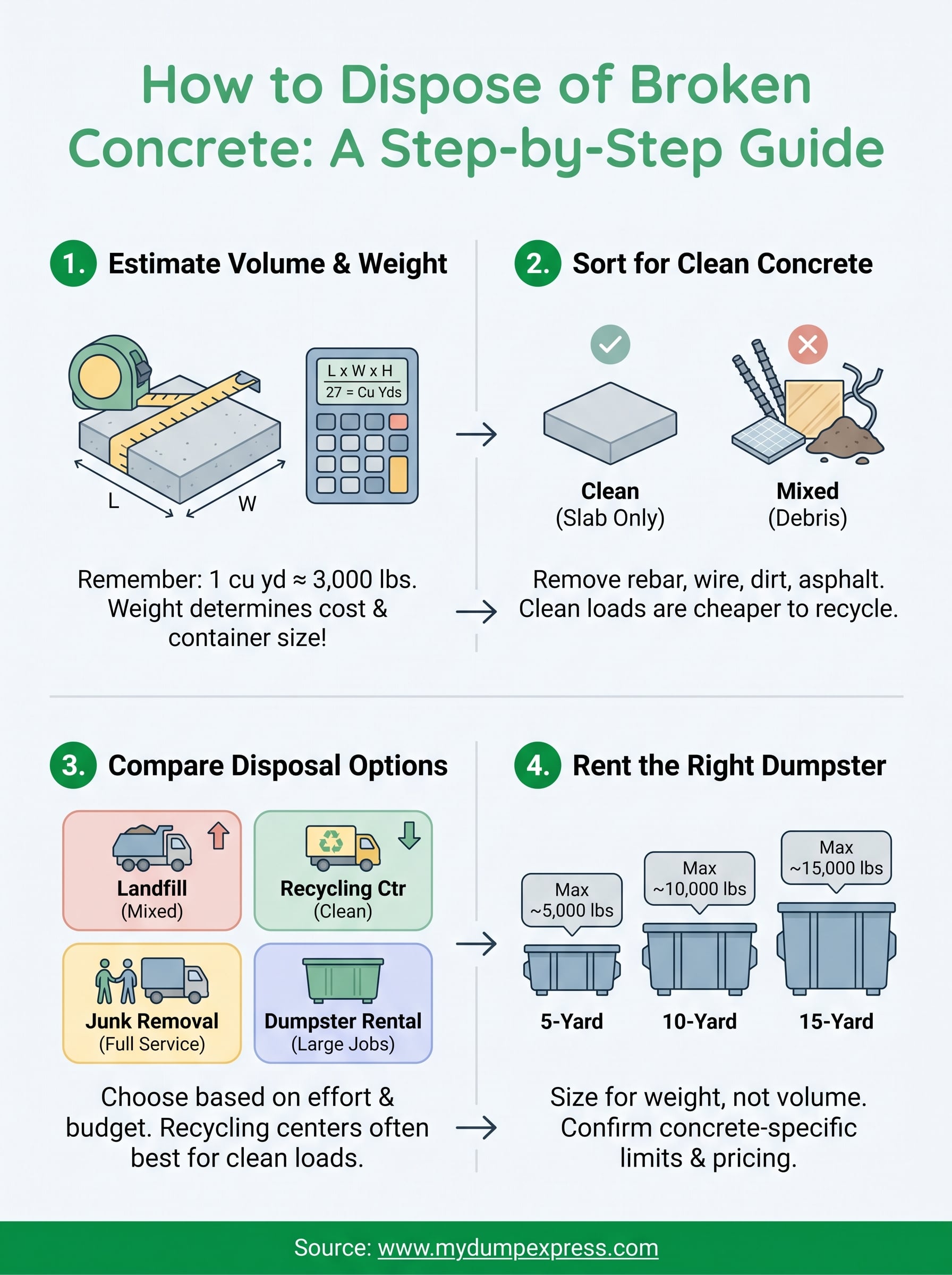
Grab a tape measure before you call anyone. Measuring your slab in length, width, and thickness lets you calculate cubic yards, which is the unit every disposal service and dumpster company uses to quote pricing. Guessing leads to renting a container that’s too small or paying for capacity you never use.
Do the math
Multiply length by width by thickness (in feet), then divide by 27 to get cubic yards. A 10-foot by 10-foot patio at 4 inches thick works out to roughly 1.2 cubic yards, which translates to about 3,000 pounds of broken concrete once removed.
Use a quick reference
Common project sizes convert like this:
| Project | Approx. Volume | Approx. Weight |
|---|---|---|
| Small patio slab | 1-2 cubic yards | 2,700-5,400 lbs |
| Single-car driveway | 3-5 cubic yards | 8,100-13,500 lbs |
| Full driveway or foundation | 8-12 cubic yards | 21,600-32,400 lbs |
Get the weight estimate right, and every other decision, from sizing to cost, gets easier.
Knowing your tonnage upfront keeps you from overloading a dumpster halfway through the job.
Step 2. Sort concrete from other debris
Once you know your volume, separate the concrete from everything else before it hits a dumpster or truck bed. Mixed loads cost more everywhere, whether you’re paying by the ton at a transfer station or by the container at a recycling yard, because facilities have to pull contaminants out by hand or reject the load entirely.
What counts as clean concrete
Clean concrete means plain slab material with no attachments. Pull out anything that doesn’t belong before loading:
- Rebar and wire mesh (metal scrap yards often take this separately, sometimes for cash)
- Tile, brick, or stone bonded to the slab
- Wood forms, stakes, or framing debris
- Dirt, sod, or landscaping material mixed in during demo
- Asphalt, which is a different material with its own recycling stream
Why sorting saves money
Separating materials on-site, even with a sledgehammer and some patience, pays off fast once you see the rate difference between clean and mixed C&D loads.
Ten minutes of sorting on the driveway can save hundreds at the gate.
Toss sorted debris into separate piles or bins so loading day goes faster and nobody’s guessing what belongs where.
Step 3. Compare your disposal and recycling options
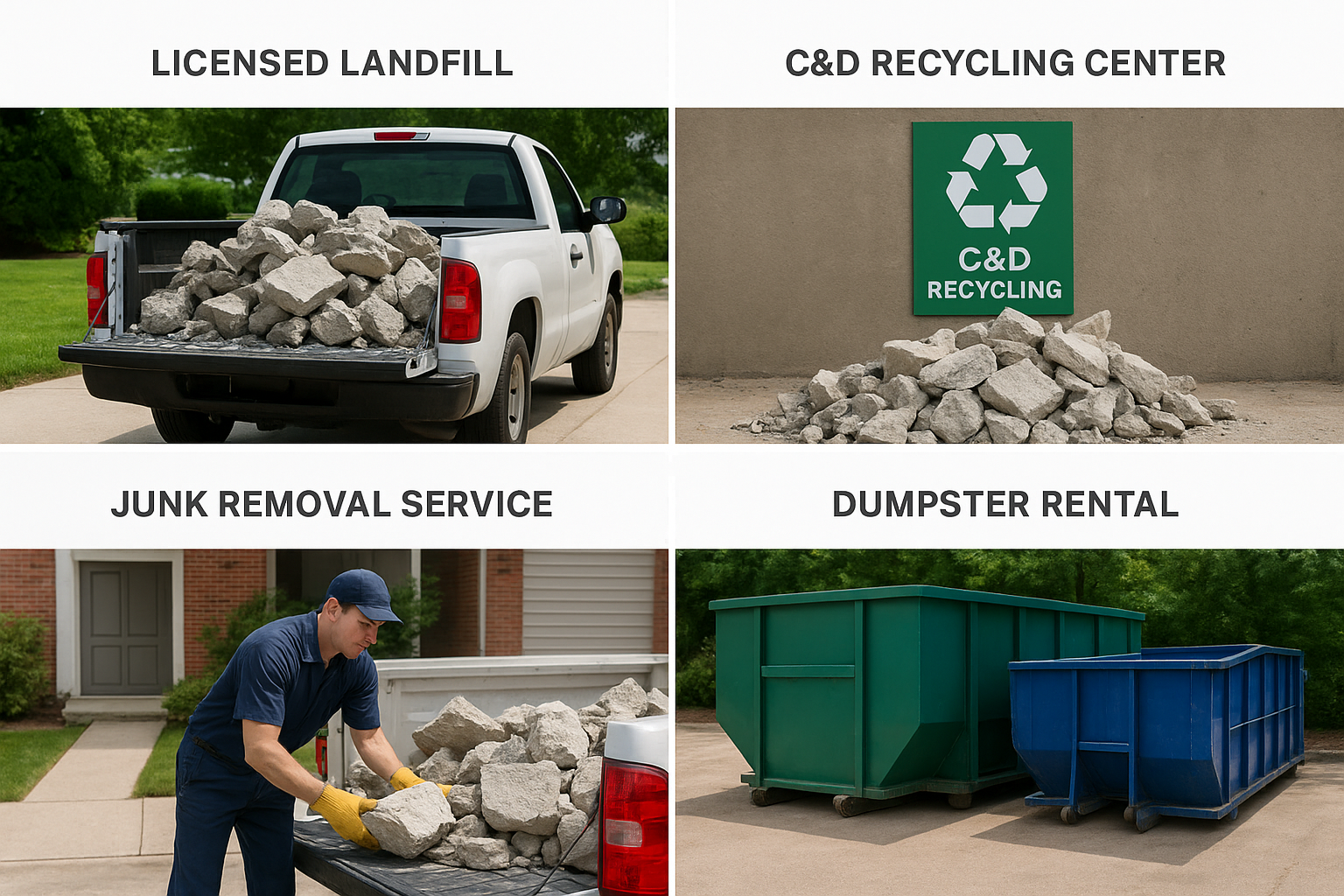
With your concrete sorted and weighed, you’re ready to pick a disposal method. Four main routes exist for getting broken concrete off your property, and each trades cost against convenience differently. A small patio job might justify a truck bed and a trip to the transfer station, while a driveway tear-out almost always calls for something bigger.
Weighing cost against convenience
Here’s how the common options stack up:
| Method | Typical Cost | Effort Required | Best For |
|---|---|---|---|
| Licensed landfill | $50-$100/ton | You haul and unload | Small loads, own truck |
| C&D recycling center | $30-$70/ton (clean loads) | You haul and unload | Clean concrete, cost savings |
| Junk removal service | $150-$600/load | Minimal, crew loads it | No truck, tight timeline |
| Dumpster rental | $400-$700/load | You load, they haul | Mid-to-large projects |
Recycling centers usually beat landfills on price, but only if your concrete is clean.
Matching the option to your project
Junk removal crews cost more per pound but save your back and your weekend. Recycling centers reward the sorting work from Step 2 with lower per-ton rates and keep material out of landfills entirely. Landfills work fine for small, mixed loads when convenience beats cost. For anything approaching a full driveway, a dumpster sized for concrete’s weight usually wins on total cost and flexibility.
Step 4. Rent a dumpster for larger concrete loads
Once your project crosses the 3 to 4 cubic yard mark, a dumpster rental almost always beats multiple truck runs to the transfer station. The trick with concrete is matching container size to weight limit, not volume, since a 20-yard dumpster looks huge but hits its tonnage cap long before it’s visually full.
Pick the right size for concrete specifically
Use this quick guide when you’re comparing containers:
- 5-yard dumpster: small patios or walkway tear-outs, up to roughly 5,000 lbs
- 10-yard dumpster: single-car driveways, up to roughly 10,000 lbs
- 15-yard dumpster: larger driveways or partial foundations, up to roughly 15,000 lbs
- 20-yard dumpster: rarely filled with pure concrete due to weight, best mixed with lighter debris
For concrete, the size that fits your driveway visually is usually too big for the weight limit.
Confirm pricing and pickup before you load
Ask about concrete-specific pricing upfront, since many companies charge differently for heavy debris than for household junk. Confirm the weight limit in writing, and schedule pickup for a day your local facility accepts C&D material so the load doesn’t sit longer than it needs to.
Clearing the way for your next project
Broken concrete doesn’t have to stall your project. Once you’ve measured your slab, sorted out rebar and debris, and matched the weight to the right method, disposal becomes a straightforward decision instead of a guessing game. Most homeowners tackling anything bigger than a walkway find that a properly sized dumpster beats truck runs and per-ton landfill fees, especially when the container is built to handle concrete’s weight instead of just its bulk.
If you’re on Cape Cod or in Plymouth and staring down a driveway, patio, or foundation tear-out, don’t guess at sizing or get stuck with surprise tonnage charges. Get a dumpster sized for your concrete project from a local team that knows the weight limits, the local transfer station rules, and how to get the right container to your driveway fast.