
Quoting a dumpster rental should not feel like negotiating a used car sale, but for a lot of homeowners and contractors it does. You call around, get three different numbers for what sounds like the same container, and none of the quotes explain what’s actually included. The 15 yard dumpster rental cost question comes up constantly because this size hits the sweet spot for kitchen remodels, roof tear-offs, and mid-size cleanouts, yet pricing varies more than people expect.
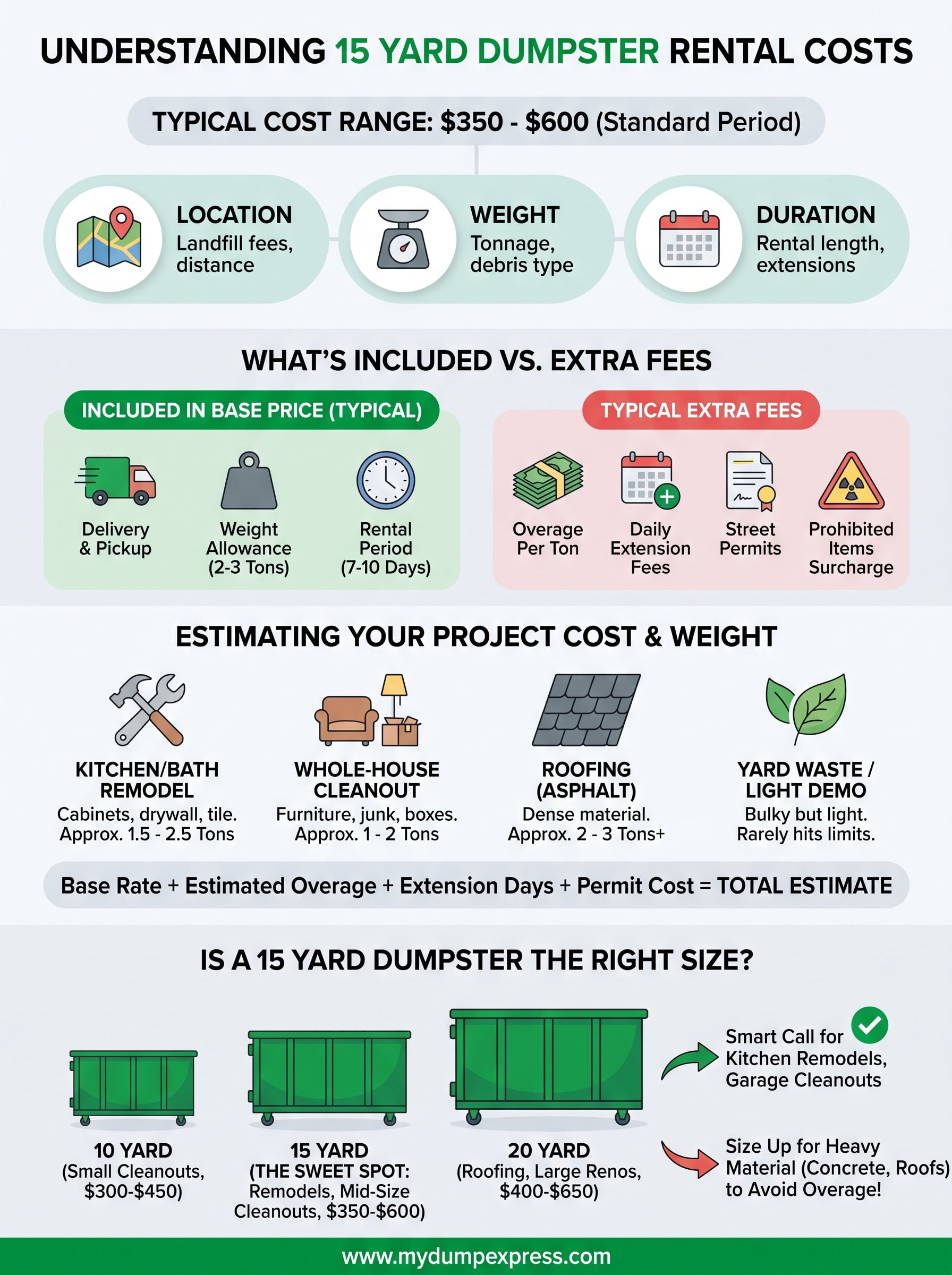
Here’s the direct answer: most 15 yard dumpsters run between $350 and $600 for a standard rental period, depending on where you live, how much weight you’ll toss in, and what’s included in the base rate. Landfill fees, rental duration, and local permit rules all push that number up or down.
In the sections below, we break down exactly what drives that range, from tonnage limits to overage charges, so you know what a fair quote looks like before you book. We’ll also cover how Cape Cod and Plymouth area pricing compares to national averages, since local disposal costs and travel distance change the math more than most guides admit.
Why 15 yard dumpster rental costs vary so much
Geography drives most of the price swing you see between quotes. Landfill and transfer station fees differ from county to county, and haulers pass those costs straight through to you. A yard in a rural area with a nearby disposal site can charge less than a company hauling debris 40 minutes to the nearest facility. On Cape Cod and in Plymouth, disposal capacity and seasonal demand both factor into local rates, which is why a price that looks reasonable in one state can look inflated (or suspiciously cheap) somewhere else.
Weight limits and what’s in your debris
Most 15 yard rentals include a set tonnage allowance, typically somewhere between 2 and 3 tons, built into the base price. Go over that limit and you’ll pay an overage fee per ton, often $50 to $100 more. This matters because not all debris weighs the same. A dumpster full of drywall, roofing shingles, or concrete will hit that weight limit far faster than the same volume of household junk or furniture. Two customers renting the identical container can end up with very different final bills simply because one filled it with shingles and the other with couch cushions and cardboard.

The size of the dumpster tells you how much space you have, not how much you’ll actually pay, weight is what determines that.
Rental period length
Standard rental windows usually run 7 to 10 days, and that’s baked into most base quotes. Need the container for three weeks because your renovation is dragging on? Expect a daily extension fee, often $5 to $15 per extra day. Contractors managing job sites should ask about extension rates before booking, since a project delay can quietly add $100 or more to a rental that looked cheap upfront.
Delivery distance and local demand
Rather than charging one flat rate across an entire region, many haulers price delivery based on how far the yard is from your address. A company with multiple yard locations can offer faster turnaround and lower delivery costs simply because they’re not driving as far. This is part of why local, multi-yard operators often beat single-location competitors on both price and reliability, especially during busy renovation seasons when trucks are booked solid.
What’s typically included versus what costs extra
Understanding the base rate structure helps you compare quotes accurately instead of getting surprised later:
| Cost factor | Usually included in base price | Usually charged separately |
|---|---|---|
| Delivery and pickup | Yes, within service area | Extra fee for long-distance drops |
| Weight allowance | 2 to 3 tons typical | Overage per ton beyond limit |
| Rental period | 7 to 10 days typical | Daily fee for extensions |
| Permit for street placement | No | Homeowner or contractor typically arranges |
| Prohibited items | Not covered | Separate disposal or surcharge |
Local regulations and permits
Some towns require a street placement permit if the dumpster will sit on a public road rather than a driveway. That permit cost, and whether you or the rental company handles the paperwork, varies by municipality. A company with deep local knowledge of Cape Cod and Plymouth area towns can tell you upfront whether your project needs one, which saves you from a fine or a delayed delivery. Companies without that local familiarity may not flag this until it’s already a problem.
Variance in dumpster rental pricing isn’t random, it reflects real differences in disposal costs, distance, weight, and local rules. Once you understand which of these factors applies to your project, a quote stops feeling like a guessing game and starts looking like straightforward math.
How to estimate your total 15 yard dumpster cost
Getting a real number before you call anyone starts with matching your project to a realistic debris estimate. Most quotes look confusing because they’re built around unknowns you can actually fill in yourself with a little homework. Once you know your project type, rough weight, and how many days you’ll need the container, the total rental cost stops being a mystery and becomes a calculation you can check against any quote you receive.
Match your project to a debris estimate
Start by picturing the volume and material, not just the square footage of your project. A single-room renovation, a garage cleanout, and a roof tear-off all fill a 15 yard dumpster differently, and weight is what actually drives your bill.
- Kitchen or bathroom remodel: cabinets, drywall, tile, roughly 1.5 to 2.5 tons
- Whole-house cleanout: furniture, boxes, mixed junk, roughly 1 to 2 tons
- Roofing job (asphalt shingles): dense material, often 2 to 3 tons or more
- Yard waste or light demo: bulky but light, rarely hits tonnage limits
Two dumpsters of the same size can cost very differently depending on what actually goes inside them.
Add up the moving parts
Because base pricing bundles delivery, pickup, and a set weight allowance, your estimate should stack these pieces together rather than guessing at one flat number. Try this rough formula before you call:
Base rental rate (7-10 days, includes weight allowance)
+ Estimated overage (if your debris likely exceeds 2-3 tons)
+ Extension days beyond the standard window ($5-$15/day)
+ Permit cost, if your town requires street placement
= Realistic total estimate
Filling in each line with even rough numbers gives you a range you can compare against quotes, instead of accepting whatever figure a call center reads off a script.
Ask for a written breakdown
Instead of accepting a single bottom-line number, ask any hauler to itemize delivery, weight allowance, and rental period separately. A company confident in its pricing will hand this over without hesitation, and it makes comparing two competing quotes far easier since you’re matching line items instead of guessing what’s hidden inside a lump sum.
Extra fees that can raise your rental price
A quote can look great on paper and still balloon once the truck shows up, and that’s usually because of fees that never made it into the original conversation. Knowing these in advance lets you ask the right questions before you sign anything, instead of arguing about a surprise charge on pickup day.
Prohibited items and contamination fees
Most haulers won’t take hazardous materials, tires, batteries, paint cans, or certain electronics in a standard dumpster, and tossing them in anyway can trigger a flat contamination fee or force the hauler to pull the whole load for manual sorting. That sorting fee can run well past $100 depending on what’s mixed in. Before you fill the container, ask for a written list of banned items, since the definition of "prohibited" shifts slightly from one disposal facility to the next.
Overweight charges
Overage fees are the most common surprise on a final invoice, and they’re also the easiest to avoid once you understand the math. If your debris pushes past the included tonnage allowance, expect a per-ton charge added automatically, often without a phone call first.
Overweight fees aren’t a penalty, they’re just the hauler passing along a real disposal cost you created.
Extended rental and rescheduling fees
Holding the dumpster longer than the standard window costs money, and so does asking for a last-minute pickup change. Common add-ons include:
- Daily extension fee: typically $5 to $15 per day past the standard rental window
- Rescheduled pickup fee: charged when you request a date change with short notice
- Trip fee for blocked access: applied if the driver can’t reach the dumpster on the scheduled day
Relocation and driveway protection
Asking the driver to move a full dumpster from a driveway to a curb, or vice versa, usually costs extra since it requires a second truck trip. Some companies also charge for driveway protection boards if you’re worried about surface damage, though many local operators include this as a courtesy rather than an add-on.
Why local knowledge prevents most of these surprises
A hauler that knows Cape Cod and Plymouth towns well can flag likely fees before delivery instead of after. That kind of upfront guidance is part of what separates a straightforward rental from one that turns into a billing dispute, and it’s the reason local expertise matters as much as the quoted price itself.
Is a 15 yard dumpster the right size for your budget
Picking a dumpster by price alone backfires more often than you’d think. Renting smaller to save $50 or $75 upfront often costs more once you factor in a second pickup, a second delivery fee, and the hassle of coordinating another truck to your driveway. Before you lock in a size, weigh the 15 yard option against its neighbors so you know you’re not paying for space you won’t use, or worse, running out of room halfway through the job.
Comparing sizes and typical costs
A side-by-side view makes the tradeoffs clearer than any description can:
| Dumpster size | Typical cost range | Best for |
|---|---|---|
| 10 yard | $300 to $450 | Small cleanouts, single-room decluttering |
| 15 yard | $350 to $600 | Kitchen/bath remodels, mid-size cleanouts |
| 20 yard | $400 to $650 | Roofing jobs, larger renovations, flooring tear-outs |
Notice the overlap between the 15 and 20 yard ranges. That overlap exists because weight, not container size, drives most of the final bill, which is why sizing advice matters more than chasing the lowest sticker price.
When 15 yards is the smart call
A 15 yard container earns its reputation as the go-to middle option for a reason. It handles projects too big for a 10 yard but too light on volume to justify a 20 yard’s higher base rate and disposal fees. Kitchen remodels, bathroom gut jobs, garage cleanouts, and mid-size decluttering projects almost always land in this range without pushing the weight limit.
Choosing the right size once beats paying for a second dumpster later.
When to size up instead
Size up if your project involves dense material like concrete, roofing shingles, or a full-house cleanout with heavy furniture. Overage charges on a 15 yard can quickly erase whatever you saved versus just booking the 20 yard from the start. Talking through your project with a local yard operator before booking beats guessing, since they’ve seen enough Cape Cod renovations to know which jobs tend to run heavier than homeowners expect. That kind of guidance, offered before you commit rather than after the truck leaves, is what keeps a 15 yard dumpster rental cost predictable instead of becoming a second invoice you didn’t plan for.
Planning your dumpster rental with confidence
A fair 15 yard dumpster rental cost comes down to knowing which factors apply to your project before you ever pick up the phone. Weight, rental period, delivery distance, and local permit rules explain almost every dollar of difference between quotes, so once you’ve matched those to your own job, you can spot a reasonable price immediately instead of guessing.
Skip the guesswork and talk to a team that quotes by town, not by script. Dump Express has spent over 20 years learning which Cape Cod and Plymouth projects run heavy, which streets need permits, and which sizes actually fit real budgets. That local knowledge is what keeps a quote from turning into a surprise invoice later.
Ready to lock in a straightforward price for your project? Get a transparent quote from Dump Express and book a dumpster that fits both your job and your budget.