
A 15 yard dumpster rental price typically falls between $350 and $550, but that number shifts depending on where you live, what you’re tossing, and who you rent from. If you’re planning a renovation, cleanout, or mid-size project on Cape Cod or the Plymouth area, knowing what drives that cost, and what should be included, helps you avoid surprise charges and choose the right service.
At Dump Express, we’ve spent over 20 years delivering dumpsters across 40+ towns in the Cape Cod region, and pricing questions are some of the most common ones we hear. People want straight answers, not vague estimates buried in fine print. That’s why we publish transparent, town-specific pricing on our website and walk customers through exactly what’s covered before they book. We believe clear pricing builds trust, and this guide reflects that same approach.
Below, we’ll break down average 15 yard dumpster rental costs nationwide, explain the factors that move the price up or down, cover what’s typically included (and what isn’t), and help you figure out whether a 15-yarder is the right fit for your project.
What a 15-yard dumpster rental price covers
When you get a quote for a 15-yard dumpster, that number doesn’t always represent the same thing from one company to the next. Some providers bundle everything into a flat rate, while others quote a low base price and layer on fees for delivery, pickup, disposal, and weight overages. Understanding what should be included in a standard rental helps you compare quotes accurately and avoid paying more than you expected when the dumpster gets picked up.
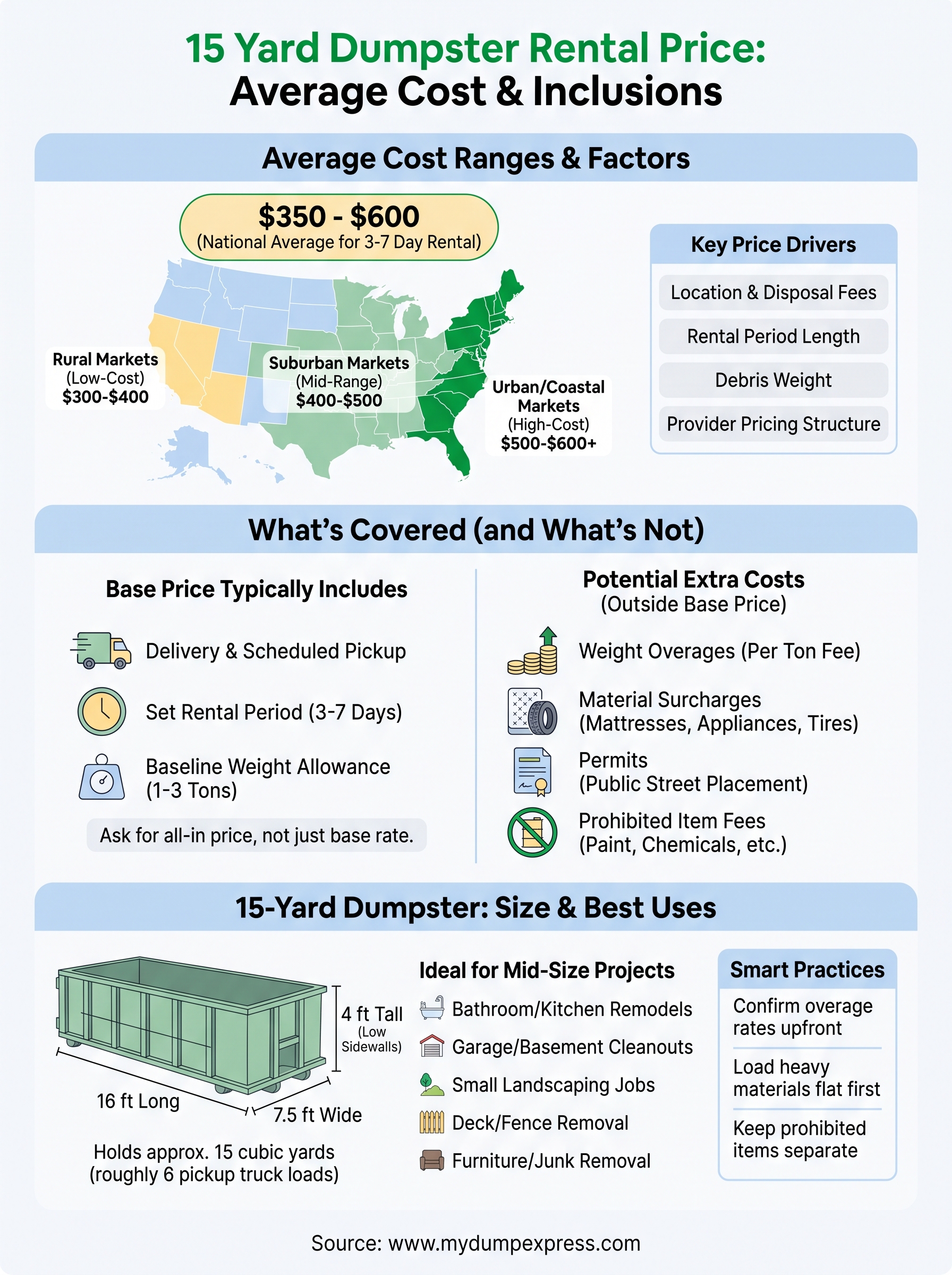
What the base price typically includes
A straightforward 15 yard dumpster rental price from a reputable provider should cover four main components: delivery to your location, scheduled pickup, a set rental period, and a baseline weight allowance for disposal. Delivery means a driver brings the dumpster to your driveway, job site, or designated drop point at the agreed time. Pickup means someone returns to haul it away once your rental period ends or when you call to schedule the pull.
The rental period and weight allowance are the two line items where pricing varies most between providers, so always confirm both before booking.
The rental period typically ranges from three to seven days for residential customers, though some companies offer longer terms for construction projects. Your quote should state clearly how many days you get and whether an extension costs extra. The weight allowance defines how many tons of debris the quoted price covers, usually somewhere between one and three tons for a 15-yarder. Exceeding that limit triggers overage charges billed per additional ton, which can add up fast on heavy material like concrete or tile.
Here’s what a complete base price should cover:
- Delivery to your address on the scheduled date
- Standard rental period (usually 3 to 7 days)
- Weight allowance for disposal (typically 1 to 3 tons)
- Scheduled pickup when your rental period ends
- Disposal fees for accepted materials at a licensed facility
What falls outside the base price
Several costs sit outside the base price, and knowing them in advance prevents unexpected charges on your final invoice. Weight overages are the most common extra cost. If your project generates more debris than your weight allowance covers, you’ll pay a per-ton fee for the difference. On a renovation or roofing job, those overages can reach $75 to $150 per additional ton depending on the market and disposal facility rates.
Certain material surcharges also apply when you include items that cost more to process at the disposal facility. Mattresses, tires, and appliances often trigger flat-fee surcharges because most facilities charge extra to handle them separately. Prohibited items, including hazardous materials like paint, chemicals, and asbestos, cannot go into the dumpster at all. Attempting to include them can result in the load being rejected at the facility, additional handling fees, or both.
Permits are another cost that may fall on you rather than the rental company. If you need to place the dumpster on a public street or in a right-of-way, your municipality may require a permit before drop-off. Most towns across Cape Cod and the Plymouth area allow dumpsters on private driveways without a permit, but street placement rules vary by town. Your rental provider should be able to tell you whether a permit applies to your drop location before you book.
Average 15-yard dumpster rental price ranges
Across the United States, a 15 yard dumpster rental price typically lands between $350 and $600 for a standard residential rental period of three to seven days. That range reflects a broad mix of markets, from rural areas with lower disposal costs to dense urban regions where landfill fees and operational costs push prices higher. Most homeowners pay somewhere in the middle, around $400 to $500, when renting from a local provider with transparent pricing.
What you’ll pay in different markets
Pricing breaks down differently depending on whether you’re in a low-cost, mid-range, or high-cost market. The table below gives you a general picture of what to expect by region:

| Market Type | Typical Price Range |
|---|---|
| Low-cost rural markets | $300 to $400 |
| Mid-range suburban markets | $400 to $500 |
| High-cost urban or coastal markets | $500 to $600+ |
These figures assume a standard rental period and a weight allowance of one to two tons. If your project produces heavier debris, or if the provider in your area charges separately for disposal, your total cost may sit above these ranges even before overage fees apply.
Always ask for the all-in price, not just the base rate, so you can compare quotes on equal footing.
What drives prices above or below average
Several variables push your final cost in either direction. Disposal facility fees in your area directly affect what rental companies charge because they pass those costs along. In coastal markets like Cape Cod and the Plymouth area, landfill access and regional regulations can make disposal more expensive than in inland markets, which is reflected in local pricing. That doesn’t mean you’re getting a worse deal. It means the true cost of disposal is baked into the quote rather than hidden in post-rental surcharges.
Rental period length also plays a role. Some companies price a three-day rental significantly lower than a seven-day rental, while others offer a flat weekly rate regardless of how long you actually keep the dumpster. If you know your project wraps up in two or three days, look for providers who price shorter rental periods fairly rather than defaulting to a full-week charge. Knowing these variables before you call makes it much easier to read a quote accurately and spot where costs might be padded.
Key factors that change your final price
Your final bill depends on more than just the container size. Several variables interact to push a 15 yard dumpster rental price higher or lower, and understanding them before you call a provider puts you in a much stronger position to budget accurately and avoid charges that catch you off guard.
Location and local disposal costs
Where you live has a direct effect on what you pay. Disposal facilities set their own tipping fees, and rental companies pass those costs along in your quote. Markets with fewer facilities nearby, stricter environmental regulations, or higher operating costs for drivers tend to have higher base prices. In coastal regions like Cape Cod, limited landfill access and regional waste regulations contribute to local pricing, which is why comparing your quote to a national average doesn’t always give you a useful reference point.
Weight of your debris
Weight is the factor most likely to create an unexpected charge after pickup. Your rental quote includes a weight allowance, typically measured in tons, and anything above that limit gets billed as an overage. Heavy materials like concrete, dirt, roofing shingles, and ceramic tile add up faster than you’d expect. A full dumpster loaded with shingles from a roof tear-off can exceed a standard two-ton allowance on its own, which is why asking about the overage rate per ton before you book matters as much as knowing the base price.
Always ask your provider what the per-ton overage rate is, not just what the weight allowance includes.
Rental period length
Keeping the dumpster longer than your original rental window usually adds a daily or weekly extension fee. Short projects that wrap up in two to three days may not need a full seven-day rental, so look for providers who price shorter terms at a lower rate rather than defaulting to the same flat charge regardless of how long you keep the container. On the other hand, if your project timeline shifts, knowing the extension rate in advance lets you plan without scrambling to call for an early pickup.
Prohibited items and material surcharges
Certain materials carry extra fees at disposal facilities, and those costs get passed to you. Mattresses, appliances, and tires typically trigger flat surcharges because processing them requires separate handling. Prohibited items like paint, chemicals, and hazardous waste cannot go in the dumpster at all, and attempting to include them can result in the entire load being rejected, which means additional haul-back fees on top of the disposal problem.
15-yard dumpster size, weight, and best uses
Understanding the physical dimensions and weight limits of a 15-yard container helps you decide whether it matches your project before you commit to a 15 yard dumpster rental price. A container that’s too small means a second haul and added cost; one that’s too large means you’re paying for space you don’t use. Getting the size right the first time is one of the easiest ways to keep your total rental cost under control.
Physical dimensions
A standard 15-yard dumpster measures approximately 16 feet long, 7.5 feet wide, and 4 feet tall. Those dimensions translate to roughly 15 cubic yards of usable interior space, which handles most mid-size residential projects without overflow. The low sidewall height makes it easy to load heavy or bulky materials without lifting them above shoulder level, which matters when you’re clearing out furniture, old flooring, or construction debris from a remodel.
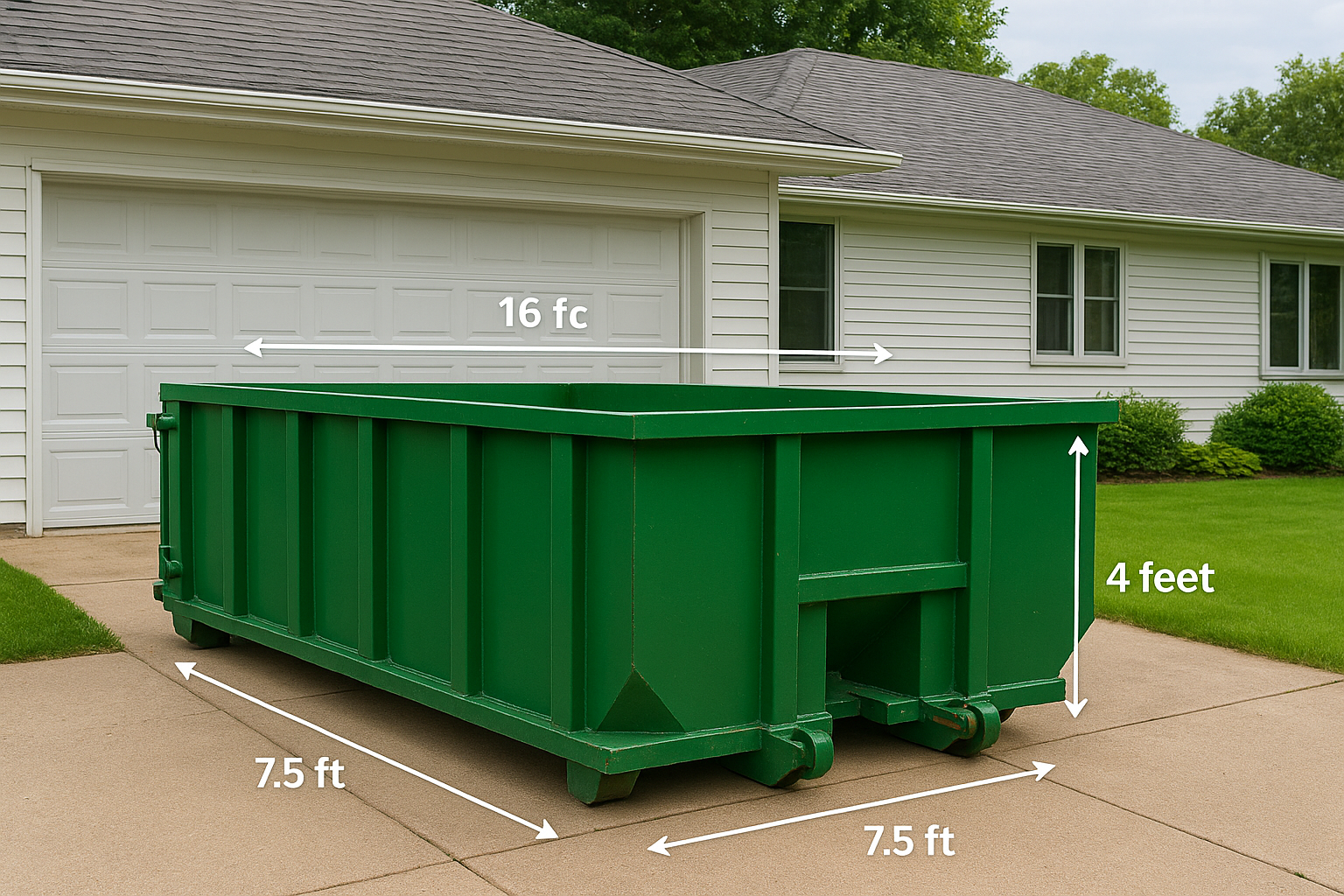
The 4-foot wall height is one of the most practical features of a 15-yarder because it keeps loading manageable without sacrificing volume.
Weight capacity and typical limits
Most 15-yard dumpsters carry a weight allowance of one to two tons in their base rental price, though the container can physically hold more depending on what you load. Heavy materials like concrete, brick, and roofing shingles get dense fast and will exceed a standard two-ton allowance before the container even looks full. If your project involves those materials, confirm the weight allowance and per-ton overage rate with your provider before you start loading, so there are no surprises on your final invoice.
Projects that fit a 15-yarder
A 15-yard container sits in the middle of the size range, making it a strong match for mid-size residential jobs that outgrow a 10-yarder but don’t need the full footprint and cost of a 20-yard container. It handles a wide range of project types without wasting capacity.
Common projects that fit well in a 15-yard dumpster include:
- Bathroom or kitchen remodels with flooring, cabinets, and fixture removal
- Single-room renovation debris including drywall and framing scraps
- Garage or basement cleanouts with mixed bulky items
- Small landscaping projects with yard waste and soil
- Deck removal or fence replacement on a standard residential lot
- Furniture and junk removal for a mid-size household cleanout
How to get an accurate quote and avoid fees
Getting a reliable 15 yard dumpster rental price starts before you ever call a provider. The more information you have about your project going in, the easier it is to ask the right questions, compare quotes on equal terms, and avoid the fees that show up on invoices because of gaps in the original booking conversation.
Ask the right questions before you book
When you contact a rental company, focus your questions on the four numbers that define your actual cost: the base price, the rental period, the weight allowance, and the per-ton overage rate. A provider who can give you clear, immediate answers to all four is one who prices transparently. One who deflects or says the overage rate depends on factors they can’t specify upfront is one worth approaching with caution.
Ask for the all-in price, not the base rate, so you know the full cost before you commit.
Before you call, estimate your project’s debris volume and material types as accurately as you can. If you’re pulling out old flooring, roofing shingles, or concrete, mention it directly so the provider can flag whether your job is likely to push past the standard weight allowance. Knowing that risk upfront lets you either upgrade your weight tier or plan to separate heavy materials for separate disposal.
Here are the key questions to ask every provider before booking:
- What is the base rental price and what does it include?
- How many days does the rental period cover?
- What is the weight allowance, and what is the per-ton overage rate?
- Are there surcharges for mattresses, appliances, or other specific items?
- Do I need a permit for my drop location?
- What items are prohibited from the container?
Avoid fees through smart loading habits
How you fill the dumpster affects your final bill more than most people expect. Heavy materials like concrete and tile should go in first, spread across the floor of the container rather than piled in one area. Distributing weight evenly reduces the chance of the load being flagged for imbalance during transport.
Keep prohibited items completely separate from the start of your project. Mixing them into a load and pulling them out later adds work and creates the risk of missing something. One prohibited item reaching the disposal facility can trigger a rejection fee that costs more than the original rental.
Ready to price your rental
A 15 yard dumpster rental price makes the most sense once you know exactly what’s included, what moves the cost up, and whether the container fits your project. You’ve now got a clear picture of average price ranges, the factors that drive overages, and the questions worth asking before you commit to any provider.
Dump Express serves Cape Cod and the Plymouth area with transparent, town-specific pricing and a team that gives you straight answers before you book. No hidden fees, no vague estimates, and no pressure to order more than your project actually needs. If you’re ready to find out what your specific project costs, check availability, or talk through the right size for your job, get a dumpster rental quote from Dump Express and get your project moving with a provider that prices honestly from the start.